Clenbuterol Before and After: What Results Actually Look Like
What do clenbuterol before-and-after results really show? Less than the photos suggest. In 2025 researchers ran the first randomised controlled trial of clenbuterol in healthy men — and found no effect on fat mass at all over a two-week cycle, despite a measurable gain in lean mass. Acutely the drug does raise metabolic rate by around 21% and fat oxidation by 39%, so it “works” in the sense people mean. But the transformations you see online are built on a calorie deficit, dehydration, tanning, lighting and timing — with the drug contributing a smaller share than anyone selling it wants you to think.
Search this phrase and you’ll find galleries of genuinely dramatic transformations. This article won’t tell you those photos are fake.
It’ll tell you something more useful: what they contain besides clenbuterol. Because in 2025 someone finally ran the trial that nobody had run, and the result reframes every one of those images.
The Trial That Changes How to Read the Photos
For decades, clenbuterol’s fat-loss reputation rested on rodent studies, livestock research and forum consensus. Randomised controlled trials in healthy humans were, in the researchers’ own description, sparse.
In 2025 that changed. A crossover trial published in The Journal of Physiology put eleven healthy men through two two-week cycles — 80 µg of oral clenbuterol daily versus placebo, separated by a three-week washout, with body composition, cardiorespiratory fitness and muscle biopsies measured throughout [1].
Read that against the marketing and the gap is striking. The compound abused specifically for leanness produced measurable muscle protein accretion and precisely nothing on fat.
The researchers were careful about the limits: two weeks is short, and diet and activity weren’t strictly controlled. But it remains the only randomised evidence in healthy humans, and it points in a direction the before-and-after galleries do not.
So why does it feel like it works?
Because acutely, it does. A separate study measured metabolic effects in young men and found that a single 80 µg dose raised resting energy expenditure by 21% and fat oxidation by 39% within a few hours [2].
Those are large numbers, and they explain the subjective experience completely — the warmth, the raised heart rate, the sense of the body running hot. Something genuinely is happening.
The awkward part is what happens over weeks rather than hours. An acute 21% rise in metabolic rate that produces no measurable fat change across a fortnight tells you the effect doesn’t compound the way people assume — and the desensitisation finding in the same trial suggests why.
But Two Weeks Is Short: The Case Against the Trial
One randomised trial doesn’t settle a question permanently, and it would be dishonest to present it as though it did. So here’s the strongest case against reading too much into it.
The researchers’ own caveats
They named two limitations directly. The treatment period was two weeks, and neither habitual physical activity nor diet was strictly controlled — both of which could affect a body composition outcome [1].
Eleven participants is also a small sample, which is normal for an invasive crossover design involving muscle biopsies, but it limits how confidently a null result can be interpreted.
The related-compound argument
The same paper notes that two to four weeks of treatment with terbutaline — a related beta-2 agonist — reduced fat mass by more than a kilogram and increased lean mass by around 1.5 kg in healthy men.
So a fat-loss effect from this class of drug isn’t implausible. It’s reasonable to argue that a longer clenbuterol cycle, or a strictly controlled diet, might have produced one.
Where that argument runs out
Two things blunt it, and they’re worth weighing.
The first is that two weeks is not an arbitrary window. The researchers chose it specifically because it’s the commonly reported cycle length among people using clenbuterol for leanness — so the trial tested roughly what real-world users actually do.
The second is the desensitisation finding. Beta-2 signalling was already downregulating within those two weeks, which cuts against the idea that a longer cycle would simply accumulate more effect.
The honest position
Not “clenbuterol does nothing for fat loss.” The acute metabolic data is real, the related-compound evidence exists, and a longer or better-controlled trial could find something.
The honest position is narrower and still consequential: the only randomised evidence we have in healthy humans, at a realistic cycle length, found no fat mass effect — which is a very long way from what the before-and-after galleries promise, and a reasonable basis for scepticism about them.
What the Photos Actually Contain
If the drug’s fat-loss contribution is smaller than advertised, the transformations still exist. So what’s in them?
A calorie deficit, doing most of the work
Nobody takes clenbuterol while eating at maintenance. Every person in every photo was also dieting, usually aggressively, usually for a deadline.
That’s the largest variable in the image and the one never credited. The compound gets the caption; the deficit did the fat loss.
Dehydration
This is the single most underestimated element. Water manipulation changes how a physique photographs more dramatically over 48 hours than fat loss does over a month — skin tightens over muscle, vascularity appears, definition sharpens.
It’s also why “after” photos so often look impossible relative to the timeframe. Two weeks cannot produce that much fat loss; two days of water manipulation can produce that much visual change.
Undisclosed stacking
Clenbuterol is frequently run alongside other compounds — often anabolic steroids, sometimes thyroid hormone. A physique built on a stack gets attributed to whichever compound the caption mentions.
Clenbuterol is frequently run alongside other compounds — often anabolic steroids, sometimes thyroid hormone. A physique built on a stack gets attributed to whichever compound the caption mentions, which is worth remembering when reading comparisons like our piece on how it stacks up against Winstrol for cutting.
Photography
The “before” is taken relaxed, in flat overhead light, after a meal, at the end of the day. The “after” is taken flexed, in directional light, fasted, in the morning, after a pump, often with a tan.
Every one of those is worth more visually than a kilogram of fat. Stack them and you have a transformation before any drug is involved.
Time
The “before” is frequently months or years older than the caption implies, and includes training and diet progress the timeline conceals.
How to Read Any Before-and-After Photo
The specifics above apply to clenbuterol. The method applies to any transformation image you’ll ever see — supplement, drug, coaching programme or diet.
Run any pair through these questions. Most fail three or more.
- Is the lighting the same? Flat overhead light flattens; directional light carves. A change of lamp outperforms a month of dieting.
- Is the posture the same? Relaxed and slouched versus braced and flexed is a different body before anything else changes.
- Has the skin tone changed? A tan sharpens definition visibly. If the “after” is browner, some of the result is pigment.
- Does the timeline fit the change? Fat loss has a physiological ceiling of roughly 0.5–1 kg a week. If the caption claims a dramatic change in a fortnight, most of it isn’t fat.
- Is the diet mentioned at all? If a transformation is credited entirely to a product with no mention of calories, the largest variable has been edited out.
- Is anything else disclosed? Stacking is common and captions are short. “Clenbuterol results” frequently means “results from several things, one of which was clenbuterol.”
- Who benefits from you believing it? A photo on a seller’s page is marketing material. That doesn’t make it false; it makes it selected.
The tell that outranks the rest
Look at the hydration cues rather than the fat. Flat, papery skin with visible vascularity and hollow-looking shoulders is a dehydrated photo, not a lean one — and that state lasts hours.
Someone photographed in it will not look like that on an ordinary Tuesday, including the person in the picture.
And one thing a good photo pair always has
Same room, same light, same time of day, same posture, same distance, same phone. Progress photos taken that way are genuinely useful and look considerably less impressive than marketing ones — which is exactly how you know they’re honest.
The Realistic Week-by-Week Arc
Below is what people commonly report, set against what’s likely happening underneath. It draws on the trial data above plus consistently described user experience.
| Phase | What users commonly report | What’s likely happening |
|---|---|---|
| Days 1–3 | Warmth, shaking hands, racing heart, appetite drop, poor sleep | Acute beta-2 stimulation. Metabolic rate genuinely elevated; no body composition change yet |
| Week 1 | Scale moving, feeling “on”, sweating more | Appetite suppression tightening the deficit; early scale change is largely water and gut contents |
| Week 2 | Tremor easing, effects feel milder | Beta-2 desensitisation — measurable in the trial within this window. Tolerance, not adaptation |
| Weeks 3–4 | “It stopped working” — often the point people raise the dose | Receptor tolerance plus a diet that’s been running long enough to slow. Raising the dose raises the cardiac load |
| Photo day | The transformation image | Peak dehydration, best light, fasted, flexed — the visual peak, not the physiological one |
| Weeks after stopping | Softer look, weight back up, energy flat | Rehydration and normal food volume returning. Appetite rebounds; the deficit ends |
| Three months on | “Where did it go?” | What remains is whatever the deficit and training built — a fraction of the visual peak |
This is an illustrative guide, not a clinically validated timeline. The timings are rough estimates based on commonly reported patterns and trial data, and may vary considerably with dose, duration, other substances used, diet and individual response. They should not be used to predict what will happen to any individual.
How Much Weight Can You Actually Lose?
The honest answer has three parts, and only one of them is about the drug.
From the deficit: whatever a deficit produces — typically 0.5–1 kg a week of genuine fat loss at a sensible rate, achievable without any compound.
From water: several kilograms of apparent change in either direction, arriving and leaving within days, and responsible for most dramatic short-timeline photos.
From clenbuterol specifically: the randomised evidence says no measurable fat mass effect over two weeks. Acutely it raises energy expenditure, which should help at the margins over longer periods — but “should help at the margins” is a very different claim from what the photos imply.
What an Honest Transformation Timeline Looks Like
Enough about what the photos get wrong. If you’re in a deficit and training, here’s what real progress looks like on a real clock — no compound required.
| Timeframe | Realistic fat loss | What you’ll actually notice |
|---|---|---|
| Week 1 | 0.5–1 kg on the scale | Mostly water and gut contents. Nothing visible. This is where most people quit. |
| Week 4 | ~2–4 kg of fat | Waistband looser. You might see it; other people won’t. |
| Week 8 | ~4–8 kg of fat | Face changes first. Clothes fit differently. Photos start to diverge. |
| Week 12 | ~6–12 kg of fat | People comment. This is where a genuine before-and-after starts to exist. |
| Week 24 | Substantial, and durable | The transformation people post — achieved on the timeline nobody posts. |
Ranges assume a moderate calorie deficit and vary considerably with starting body fat, adherence and individual factors. Heavier starting weights lose faster in absolute terms; leaner people lose more slowly and should aim at the lower end.
Why the mirror lags the scale
Fat loss is distributed, not local. Losing three kilograms takes a thin layer off everywhere rather than a visible chunk from one place, which is why the scale moves for weeks before the mirror agrees.
It’s also why week four is the most common quitting point, and why the people who post transformations are disproportionately the ones who got past it.
How to tell water from fat in your own numbers
Use weekly averages, not daily weights. Day-to-day swings of a kilogram or two are food volume, sodium, hydration and gut contents. The weekly average is the signal; the daily number is noise.
Take a tape measurement. Waist at the navel, same time of day, weekly. It’s less volatile than the scale and tracks fat more honestly.
Photograph in fixed conditions. Same room, same light, same time, same posture, monthly rather than weekly. Change is invisible at seven-day intervals and obvious at thirty.
And remember the rule that settles most confusion: a two-kilogram change overnight is never fat. Creating or removing two kilograms of adipose tissue takes roughly 14,000 calories of energy imbalance, which cannot happen while you sleep.
The Column the Photos Don’t Have
Every before-and-after image has two panels. The trial data suggests there should be a third, showing what changed where the camera can’t look.
In the same two-week cycle that produced no fat loss, researchers recorded attenuated cardiorespiratory fitness and repressed muscle oxidative capacity — markers of aerobic function moving in the wrong direction [1].
And that’s from a supervised trial at a controlled dose. The published clinical literature on unsupervised use is a run of cardiac cases — atrial fibrillation, raised troponin, myocardial infarction in people with clean coronary arteries — which our Clenbuterol side effects guide goes through in detail.
None of that photographs. It’s the invisible half of every transformation image in the category.
Why “It Stopped Working” Happens
This complaint appears in every forum thread on the subject, and until 2025 the explanation was guesswork. Now there’s a measurement.
The trial found beta-2 adrenergic signalling in muscle desensitising over the two-week cycle — the receptors becoming less responsive to the drug while the cycle was still running [1].
So the fading effect people describe isn’t imagination or a bad batch. It’s a documented pharmacological process, and it’s why the standard response — raising the dose — is the worst available one.
Raising the dose to chase a receptor that’s downregulating means increasing cardiac exposure to pursue a diminishing return. Combined with clenbuterol’s long half-life, where doses accumulate rather than clear between them, that’s the sequence behind a meaningful share of the overdose cases in the literature.
What About the Legal Alternatives?
Expectations first, since this article has spent its length arguing for realistic ones.
Legal thermogenics contain no beta-2 agonist and won’t reproduce clenbuterol’s acute metabolic spike — the mechanism gap is set out in our comparison of the drug against the supplement named after it. What a well-dosed one does is raise daily energy expenditure by a few percent and improve training energy, on top of a deficit you still create yourself.
That sounds unimpressive next to the photos. Given that the randomised evidence found no fat mass effect from the drug itself over two weeks, the gap between the two options is narrower than the marketing on either side suggests.
The Legal Alternative: Clenbutrol
A food supplement, not a drug — with expectations set by this article rather than the marketing.
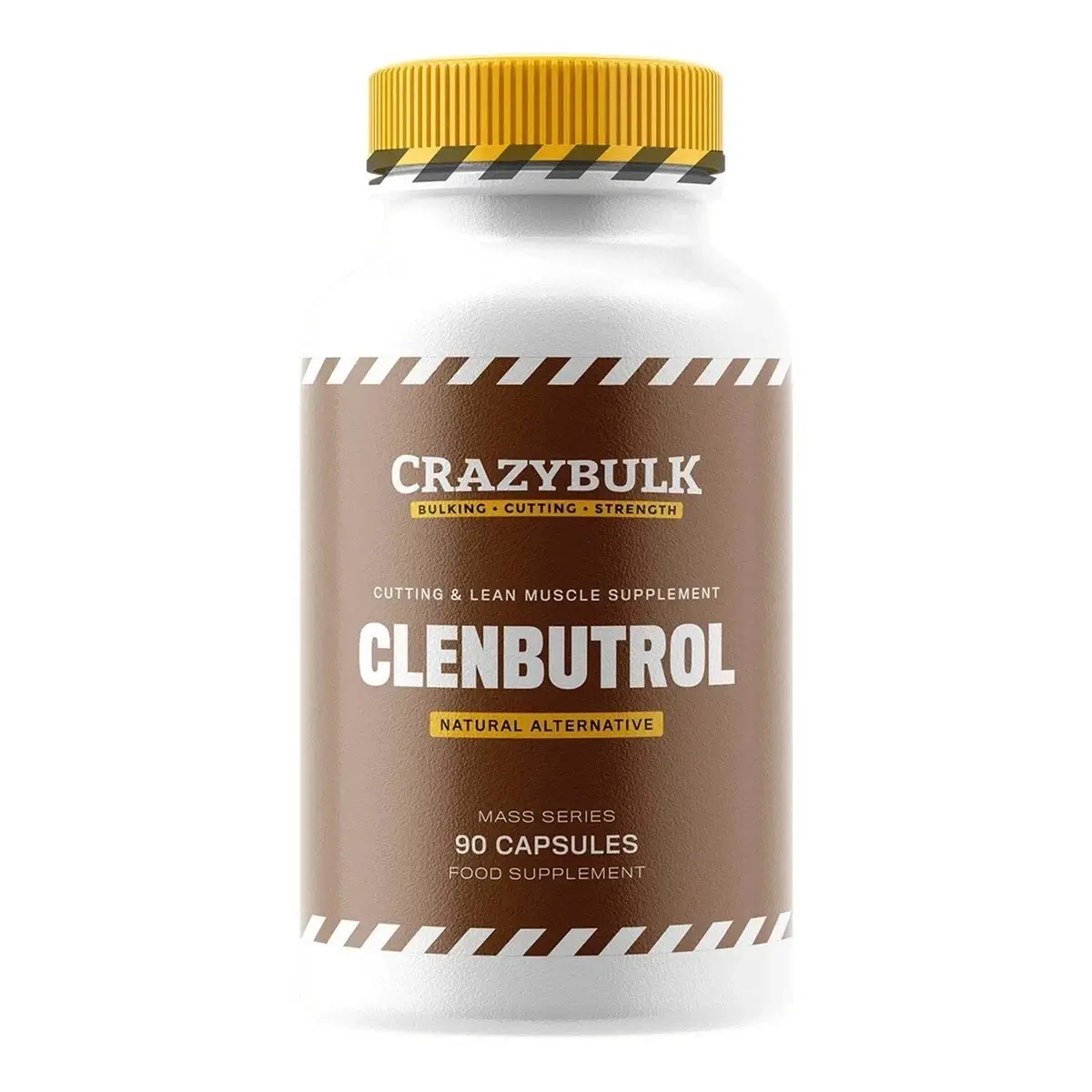
Clenbutrol — CrazyBulk
Thermogenic supplement · 4 capsules daily · £49.99 per month
- Legal to buy, possess and use in the UK — no supply or importation offence, no seizure risk
- Every dose printed on the label, from a company with a published address
- No beta-2 agonist — and so none of the receptor-driven cardiac risk
- 60-day money-back guarantee
- Contains 200 mg caffeine, a real stimulant dose with its own cautions
- Won’t replicate clenbuterol, and works alongside a deficit rather than instead of one
FAQ
How much fat can you lose on clenbuterol in two weeks?
The only randomised trial in healthy men found no measurable change in fat mass over a two-week cycle. Any weight lost in that window is more plausibly explained by the calorie deficit, appetite suppression and water shifts than by the compound itself.
Are clenbuterol before-and-after photos real?
Most are real photos of real people — taken at peak dehydration, in optimised lighting, after a diet, and frequently with other compounds involved. Real image, misleading attribution.
Why did clenbuterol stop working after two weeks?
Beta-2 receptor desensitisation, which was measured directly in the 2025 trial within that same window. Raising the dose in response increases cardiac exposure while chasing a receptor that’s downregulating.
Do the results last after you stop?
The visual peak doesn’t — water returns, appetite rebounds and the diet usually ends. What persists is whatever the deficit and training built, which is the honest measure of any cycle.
Does clenbuterol build muscle?
The 2025 trial found a 0.91 kg lean mass gain over two weeks alongside increased muscle protein content — so there’s a measurable anabolic signal. It came with reduced cardiorespiratory fitness and repressed muscle oxidative capacity in the same participants.
Is it legal to buy clenbuterol in the UK?
No lawful route exists — it has no human licence here, and supply and postal importation are offences, though possession for personal use is not. The position is set out in our guide to where UK law stands on it.
References
- Hostrup M, et al. Clenbuterol induces lean mass and muscle protein accretion, but attenuates cardiorespiratory fitness and desensitizes muscle β2-adrenergic signalling. The Journal of Physiology, 2025. https://physoc.onlinelibrary.wiley.com/doi/10.1113/JP289023
- Jessen S, et al. Beta2-adrenergic agonist clenbuterol increases energy expenditure and fat oxidation, and induces mTOR phosphorylation in skeletal muscle of young healthy men. Drug Testing and Analysis, 2020. https://analyticalsciencejournals.onlinelibrary.wiley.com/doi/abs/10.1002/dta.2755
- Case report and review of clenbuterol cardiac toxicity. Journal of Cardiology Cases, 2013. https://www.sciencedirect.com/science/article/pii/S1878540913001011
- Clenbuterol toxicity: an emerging epidemic. A case report and review. PubMed. https://pubmed.ncbi.nlm.nih.gov/17393901/
- The Misuse of Drugs Act 1971 (Modification) Order 1996, SI 1996/1300 — legislation.gov.uk. https://www.legislation.gov.uk/uksi/1996/1300/made
- Medicines and Healthcare products Regulatory Agency (MHRA) — GOV.UK. https://www.gov.uk/government/organisations/medicines-and-healthcare-products-regulatory-agency
- NHS — Anabolic steroid misuse. https://www.nhs.uk/conditions/anabolic-steroid-misuse/
- UK Anti-Doping — British triathlete receives three-year ban for possession and use of clenbuterol. https://www.ukad.org.uk/news/british-triathlete-louis-walker-receives-three-year-ban-for-possession-and-use-of-clenbuterol
This article is for information and harm-awareness. It does not provide dosing information, does not identify sellers or sources, and is not medical advice — if you’re experiencing symptoms after taking anything described here, seek medical attention. NHS services treat these issues without judgement.

Tanveer Quraishi, author of Steroids 101 has extensive experience in the field of bodybuilding and has been writing online on various muscle-building and other health topics for many years now. He is not just interested in bodybuilding but is a great football player too. When he is not writing for his site or training at the gym, he loves to spend his time with this wife and kids.