Vitamin D and Testosterone: Why Most Men in the UK Are Deficient and What to Do About It
Nearly 50% of UK adults have vitamin D levels below the optimal range. For men aged 18–29, that figure rises to 56% — more than half of young UK men running hormonally short for months on end.

The reason is geographical. 90% of our daily vitamin D requirement comes from UVB sunlight on the skin, which in the UK only occurs during April to September. Between October and March, most men aren’t producing any.
What makes this urgent is the research now showing a direct, causal link between vitamin D and testosterone production. If you’re not addressing this deficiency, your hormones may be paying the price without you ever making the connection.
The Vitamin D–Testosterone Connection: What the Research Actually Shows
The relationship between vitamin D and testosterone is no longer a hypothesis. It’s a well-documented association supported by multiple lines of evidence including observational studies, randomised controlled trials, and genetic analysis.
Testosterone by vitamin D status:
Based on Pilz et al. (2011, Journal of Clinical Endocrinology and Metabolism, n=2,299 men) and subsequent systematic review evidence. A causal relationship confirmed by Mendelian randomisation (JCEM, 2019). Values are indicative averages — individual results vary. NHS testosterone deficiency threshold is below 8 nmol/L; grey zone 8–12 nmol/L.
A 2023 systematic review evaluated eight studies — including four cross-sectional studies, three RCTs, and one Mendelian randomisation analysis. The findings consistently pointed in the same direction: lower vitamin D correlates with lower testosterone, and correcting deficiency through supplementation raises testosterone levels.
The landmark study comes from Pilz et al. (2011), published in the Journal of Clinical Endocrinology and Metabolism. In 2,299 men, researchers found a significant positive association between 25-hydroxyvitamin D and total testosterone — even after adjusting for age, BMI, and season.
The mechanism makes biological sense. Vitamin D receptor genes are expressed in Leydig cells — the testosterone-producing cells in the testes. This isn’t a loose correlation without an explanatory pathway; the biology directly supports what the population data shows.
More recently, a Mendelian randomisation analysis — which uses genetic data to establish causation rather than mere association — identified a causal link between vitamin D and testosterone in men. Mendelian randomisation is considered one of the strongest forms of non-experimental evidence, making this finding particularly significant.
The connection extends beyond testosterone itself. A 2025 systematic review of over 13,000 men found a strong association between low vitamin D and erectile dysfunction. For UK men experiencing the full symptom cluster of hormonal decline, vitamin D is relevant at multiple levels simultaneously.
Why the UK Is Uniquely Vulnerable
The vitamin D problem exists across the northern hemisphere, but the UK has specific circumstances that make it worse than most.
Vitamin D by UK region
Source: Medichecks analysis of 130,000+ UK blood test results. Values represent average serum 25-hydroxyvitamin D (nmol/L). NHS sufficiency threshold is 50 nmol/L; optimal is 75 nmol/L and above. Seasonal variation means winter levels will be significantly lower than these year-round averages.
Vitamin D by age group in UK men
Source: Forthwith Life UK blood test data and published UK population studies. Younger men have lower vitamin D despite greater synthesis potential — driven by indoor working culture, gym-based training, and low supplement compliance. Older adults often supplement more consistently, explaining the counterintuitive upward trend with age.
From late March to late September, most people in the UK can make adequate vitamin D from sunlight. From October to early March, the sun is simply not strong enough — and there is zero UVB synthesis happening, regardless of how much time you spend outdoors.
That's six months of every year when dietary and supplemental sources are the only option. Most UK men aren't adequately using either.
UK sunshine hours calendar heatmap:
Months with zero UVB synthesis
5 months
Peak synthesis window
Jun – Aug
Supplement needed from
Oct – Mar
% of year with no/minimal UVB
~58%
Based on UK latitude (51–57°N) UVB data and NHS vitamin D synthesis guidance. UVB synthesis requires the sun to be above ~35° elevation. Sunshine hours shown are average UK monthly figures. Sunscreen, clothing, and glass all block UVB synthesis even when the sun is above the threshold angle. Individual synthesis also varies by skin tone, age, and body surface area exposed.
Even during the synthesis window, indoor working culture works against men. Younger UK men tend to have lower vitamin D than older generations — partly due to desk jobs, gym-based training, and indoor hobbies that replace outdoor time.
Certain subpopulations face a significantly heightened year-round risk. Up to 92% of UK-dwelling South Asian adults and 84% of African-Caribbean individuals have insufficient vitamin D levels, due to the greater melanin content of darker skin requiring longer UV exposure to produce the same amount.
The geography, the climate, and the modern working lifestyle combine to make vitamin D deficiency the UK's most predictable — and most overlooked — hormonal risk factor for men.
| Risk group | Risk level | Why they're at risk | What to do |
|---|---|---|---|
| UK men with darker skin (South Asian, African-Caribbean heritage) | Critical | Higher melanin content requires significantly longer UV exposure to produce the same vitamin D. Up to 92% of UK-dwelling South Asian adults and 84% of African-Caribbean adults have insufficient levels — a year-round problem, not just seasonal | Year-round supplementation recommended — not just October to March. Aim for 1,000–2,000 IU D3 daily. Test annually to confirm levels are adequate |
| UK men aged 18–29 with indoor lifestyles | Critical | 56% of UK men aged 18–29 have below-optimal vitamin D. Desk jobs, gym-based training, and indoor hobbies mean even the summer synthesis window goes largely unused | Supplement October–March as minimum. Prioritise outdoor lunchtime walks during summer. Test in October to understand your personal baseline |
| Men living in northern UK (Scotland, northern England) | High | North East England has the lowest average vitamin D levels in the UK at 71 nmol/L. Greater latitude means weaker UVB radiation even during the summer synthesis window | Supplement year-round rather than just October–March. Test in September at end of synthesis window to understand your actual summer baseline |
| Men who work indoors all day (office workers, drivers, shift workers) | High | No meaningful UVB exposure during working hours for most of the year. Even in summer, commuting by car and working behind glass provides no vitamin D synthesis — glass blocks UVB | Year-round supplementation makes sense for this group. Short outdoor breaks during summer lunch hours are the most accessible free intervention |
| Overweight or obese men | High | Vitamin D is fat-soluble and becomes sequestered in adipose tissue. Men with higher body fat require more vitamin D to achieve the same circulating serum level as leaner men | May need higher supplementation doses (2,000 IU+ daily) to achieve adequate serum levels. Testing is particularly important to confirm whether supplementation is working |
| Men over 60 | Moderate | Skin's capacity to synthesise vitamin D declines significantly with age. Older men also tend to spend less time outdoors and eat less overall, reducing both synthesis and dietary intake | Year-round supplementation is advisable. NHS GP appointment to test and potentially prescribe treatment if levels are confirmed low |
| Men with malabsorption conditions (Crohn's, coeliac, IBS) | Moderate | Vitamin D is a fat-soluble vitamin absorbed through the gut. Conditions affecting fat absorption significantly reduce vitamin D uptake even from supplements | Speak to your GP — standard supplementation may not be sufficient. Higher doses or specific formulations may be needed. Regular testing is essential for this group |
| Men on certain medications (anticonvulsants, corticosteroids, rifampicin) | Moderate | Several commonly prescribed UK medications accelerate vitamin D metabolism or reduce absorption, including some epilepsy, inflammatory, and infection medications | Discuss vitamin D status with your prescribing GP. Testing and adjusted supplementation may be appropriate alongside your existing medication |
Sources: Medichecks UK blood test data (130,000+ results), NHS vitamin D guidelines, SACN vitamin D and health report, and published UK population studies. Risk levels reflect both prevalence of deficiency and severity of the underlying mechanism driving it.
Overlapping Symptoms: How Do You Know Which Is Which?
Low testosterone and vitamin D deficiency share almost identical symptoms: fatigue, low mood, muscle weakness, reduced libido, and brain fog. This creates a real diagnostic challenge.
Without blood tests for both, you're guessing which condition is driving your symptoms — and that guess could lead you down entirely the wrong treatment path.
The good news is that correcting vitamin D deficiency alone sometimes produces meaningful improvements in testosterone-related symptoms without any other intervention. For some men, vitamin D may be a significant — or even the primary — contributor to how they've been feeling.
The practical answer is to get both tested simultaneously. A serum 25-hydroxyvitamin D test and a morning testosterone blood test together give you the full picture in one go.
What the NHS Recommends (And Why Most Men Aren't Following It)
The NHS is clear: adults need 10 micrograms (400 IU) of vitamin D daily, and everyone in the UK should supplement from October to March due to insufficient sunlight. High-risk groups may require year-round supplementation.
Despite this being official public health guidance, nearly half of UK adults are unaware of the supplement recommendation. More than half don't take supplements at all, or take them inconsistently.
There's also an important nuance in the dosing. The NHS recommendation of 400 IU is a floor to prevent deficiency in the general population — it's not an optimisation target. Many clinicians argue that men with confirmed deficiency, or those targeting hormonal health, benefit from 1,000–2,000 IU daily, particularly through the deficiency window.
Research showed that just 13 minutes of midday summer sun exposure, three times a week for six weeks, raised vitamin D levels above 50 nmol/L in 90% of Caucasian British participants. Brief, consistent outdoor exposure during the synthesis window makes a meaningful difference — but most UK men aren't getting even this.
How to Get Tested for Vitamin D Deficiency in the UK
A blood test measuring your serum 25-hydroxyvitamin D (25-OHD) level is the only reliable way to know where you stand. Here's how UK reference ranges break down:
- Below 25 nmol/L: Deficient — NHS and SACN guidance classifies this as deficiency, with increased risk of musculoskeletal health problems
- 25–50 nmol/L: Insufficient — may be adequate for some but below optimal for most
- 50–75 nmol/L: Sufficient for most people by NHS standards
- Above 75 nmol/L: Optimal — the level most associated with broader health benefits including hormonal support
| Level (nmol/L) | Classification | NHS / clinical response | What it means for testosterone | Action needed |
|---|---|---|---|---|
| <25 nmol/L | Deficient | NHS and SACN classify this as deficiency — increased risk of bone disease, muscle weakness, and poor immune function. GP referral and loading dose typically required | Significant suppression of testosterone likely — Leydig cell function impaired. Symptoms of low T and vitamin D will overlap and compound each other | See your GP urgently. A loading dose of vitamin D is usually prescribed. Retest after 3–6 months |
| 25–50 nmol/L | Insufficient | May be adequate for some but insufficient for most. NHS guidelines consider this a grey zone — treatment depends on symptoms and risk factors | Testosterone production may be meaningfully impaired at this level — the range where many symptomatic men fall without receiving treatment | Supplement at 1,000–2,000 IU vitamin D3 daily. Retest in 3 months. Discuss with GP if symptoms of low T are present |
| 50–75 nmol/L | Sufficient | NHS standard sufficiency threshold. Adequate for bone health and most physiological functions in the general population | Testosterone is unlikely to be significantly suppressed by vitamin D deficiency at this level — though optimal hormonal support may require higher levels | Maintain with 400–1,000 IU D3 daily through winter. Aim for outdoor sun exposure during the synthesis window (April–September) |
| >75 nmol/L | Optimal | Associated with broader health benefits beyond bone health — cardiovascular, immune, and hormonal. This is the target level for men optimising their overall health | The level most associated with healthy testosterone production and positive hormonal outcomes in research. Only 50% of UK adults reach this level at peak season | Maintain with consistent supplementation (1,000–2,000 IU D3) through winter and regular outdoor exposure in summer. Retest annually in autumn |
Source: NHS, SACN (Scientific Advisory Committee on Nutrition), and published clinical research. Reference ranges expressed as nmol/L — the UK standard unit. To convert from ng/mL (US unit), multiply by 2.5. Individual clinical decisions should always be made with a qualified healthcare professional.
Routine vitamin D testing isn't offered to asymptomatic people on the NHS. The practical options are a private home blood test (Medichecks, Forth, and similar services offer finger-prick tests from around £25–£35), or a GP referral if you have symptoms that justify it.
Testing in October or November is particularly useful. It captures your level at the end of the synthesis window — just before it drops further through winter.
How to Fix It: A Practical UK Guide
Here's how you can fix or increase your Vitamin D intake:
Supplementation
For most UK men, supplementation from October to March is non-negotiable. For many, year-round supplementation makes sense given the indoor lifestyle described above.
Choose vitamin D3 (cholecalciferol) over D2. D3 is the form naturally produced by the skin and is more effective at raising serum levels.
The NHS recommends 400 IU daily for the general population. For men with confirmed deficiency or those targeting hormonal health, 1,000–2,000 IU daily is a widely used and well-tolerated dose.
Take vitamin D3 alongside vitamin K2 (MK-7 form). The two work synergistically — K2 directs calcium to bones rather than soft tissues, which becomes relevant at higher D3 doses. Take both with a fatty meal for optimal absorption.
Sun Exposure
During the synthesis window (late March to late September), prioritise outdoor time between 10am and 3pm with skin exposed. Arms and legs are the most efficient exposure areas.
Short, frequent exposures work better than prolonged sessions. A lunchtime walk with rolled-up sleeves during summer is one of the most effective, free interventions available.
Sunscreen blocks UVB synthesis, so brief unprotected exposure before applying is appropriate. Don't stay out long enough to burn — little and often is the right approach.
Food Sources
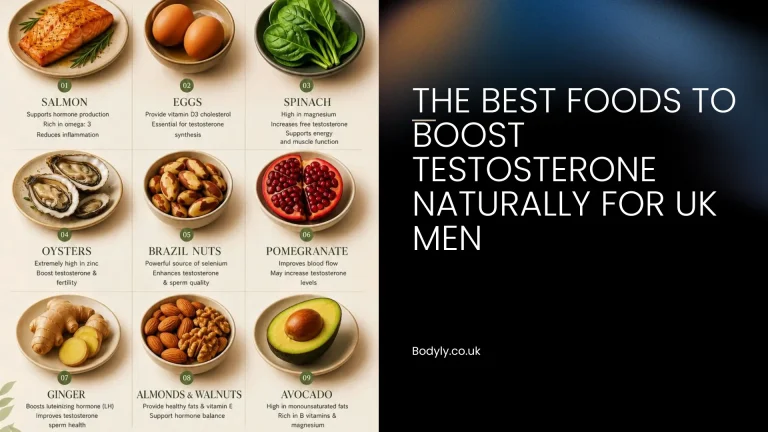
Dietary vitamin D is limited but meaningful as a supplementary contribution. The best UK-available food sources are fatty fish (salmon, mackerel, sardines), egg yolks (which are excellent test boosting foods), and fortified cereals and dairy spreads.
Unlike some other countries, UK milk is not fortified with vitamin D. Two to three portions of oily fish per week — tinned mackerel or sardines are the most affordable options — meaningfully support intake year-round.
| Food | Vitamin D per serving | Rating | UK availability | Practical tip |
|---|---|---|---|---|
| Salmon (100g cooked) | ~400–600 IU | High | All supermarkets fresh and tinned — tinned is affordable year-round | Two portions per week comfortably meets dietary vitamin D needs during winter. Fresh or tinned — both equally nutritious |
| Mackerel (100g cooked) | ~400 IU | High | All supermarkets — tinned mackerel in brine or tomato sauce is among the cheapest oily fish available | The most affordable high-vitamin D food in the UK. Tinned mackerel on wholegrain toast is a quick, nutritionally dense meal |
| Sardines (tinned, 100g) | ~270–300 IU | High | Every UK supermarket — widely available and very affordable | Often overlooked but genuinely excellent value. Eating the small bones also provides calcium — a bonus for testosterone-supporting bone health |
| Herring / kippers (100g) | ~800–1,000 IU | High | Most UK supermarkets — kippers are a traditional British breakfast staple | The single highest-vitamin D food available in the UK diet. Two kippers provide close to the NHS daily recommendation in one meal |
| Egg yolks (2 large) | ~80–120 IU | Medium | Every UK supermarket — among the most affordable and versatile foods available | A meaningful daily contribution when eaten consistently. Free-range and outdoor-reared eggs contain higher vitamin D than caged alternatives |
| Fortified cereals (30g serving) | ~40–100 IU | Medium | All supermarkets — most mainstream UK breakfast cereals are fortified | Useful as a consistent daily contribution but not sufficient on its own. Check the label — vitamin D content varies significantly between brands |
| Fortified dairy spreads / margarine (10g) | ~30–40 IU | Low | All supermarkets — standard in UK kitchens | Minor but consistent daily contribution. Note: unlike some countries, standard UK cow's milk is not fortified with vitamin D |
| Beef liver (100g) | ~50–70 IU | Low | Butchers and most supermarkets — very affordable | Also provides zinc, iron, and B vitamins — a useful nutrient-dense addition for men managing multiple hormonal gaps. Limit to once per week due to high vitamin A content |
Note: even eating oily fish 2–3 times per week provides only 200–400 IU of vitamin D daily from food alone. The NHS recommends supplementation throughout winter for all UK adults regardless of dietary intake. IU values are approximate and vary by preparation method and food source.
A Note on Natural Support: Testosil
Sponsored/affiliate content — does not constitute medical advice.
For UK men looking to address vitamin D alongside the other nutritional deficiencies that undermine hormonal health, Testosil includes vitamin D as part of its core formula — alongside zinc, magnesium, and KSM-66 ashwagandha.

The seasonal timing makes this particularly relevant. The deficiency window runs October to March — the same months when UK men are training less, sleeping worse, eating more comfort food, and managing higher work stress. This is the window where the cumulative hormonal toll is greatest.
A supplement addressing multiple deficiencies simultaneously makes more practical sense during this period than addressing each one in isolation. Testosil isn't a replacement for testing or for treating a clinically deficient level with a proper loading protocol — but as part of a comprehensive winter approach to hormonal health, it's one of the more thoughtfully formulated options available.
Click here to read my honest Testosil review.
Disclosure: This section may contain affiliate links. We may earn a small commission at no extra cost to you.
FAQs
How long does it take for vitamin D supplementation to raise testosterone?
Most studies showing meaningful testosterone improvements from vitamin D supplementation used a timeframe of 12 months, though some men report symptom improvements within 8–12 weeks of correcting a confirmed deficiency.
Can I get enough vitamin D in the UK without supplements?
During April to September you can if you spend regular time outdoors at midday, but from October to March the UK sun is too weak for any skin synthesis — making supplementation essential for the general population during those months.
Does vitamin D directly raise testosterone or just fix a deficiency?
A 2019 Mendelian randomisation study confirmed a causal relationship — meaning vitamin D genuinely supports testosterone production — but the benefit is most pronounced when correcting a deficiency rather than supplementing above already-adequate levels.
Should I take vitamin D if I'm already on TRT?
Yes — a 2025 study found that vitamin D status significantly influences the cardiometabolic benefits of TRT in men with hypogonadism, meaning adequate vitamin D helps TRT work more effectively rather than the two being interchangeable.
Final Thoughts
Half of UK men are running with below-optimal vitamin D for large parts of the year. The research now points to a causal — not just correlational — relationship with testosterone.
The fix is neither complicated nor expensive. Test in autumn. Supplement consistently through winter. Get outside during the synthesis window. Eat oily fish regularly.
The NHS recommendation to supplement from October to March exists for a reason. If you're not following it, your hormones may be quietly paying the price.

Tanveer Quraishi, author of Steroids 101 has extensive experience in the field of bodybuilding and has been writing online on various muscle-building and other health topics for many years now. He is not just interested in bodybuilding but is a great football player too. When he is not writing for his site or training at the gym, he loves to spend his time with this wife and kids.