The Ectomorph & Hardgainer Guide to Cutting: How Skinny Guys Get Shredded Without Vanishing (UK Guide 2026)
Here’s the cruel irony nobody warns hardgainers about: you spend years fighting for every pound of muscle — and then one bad cut can strip it away in eight weeks. Years of work, gone in two months.
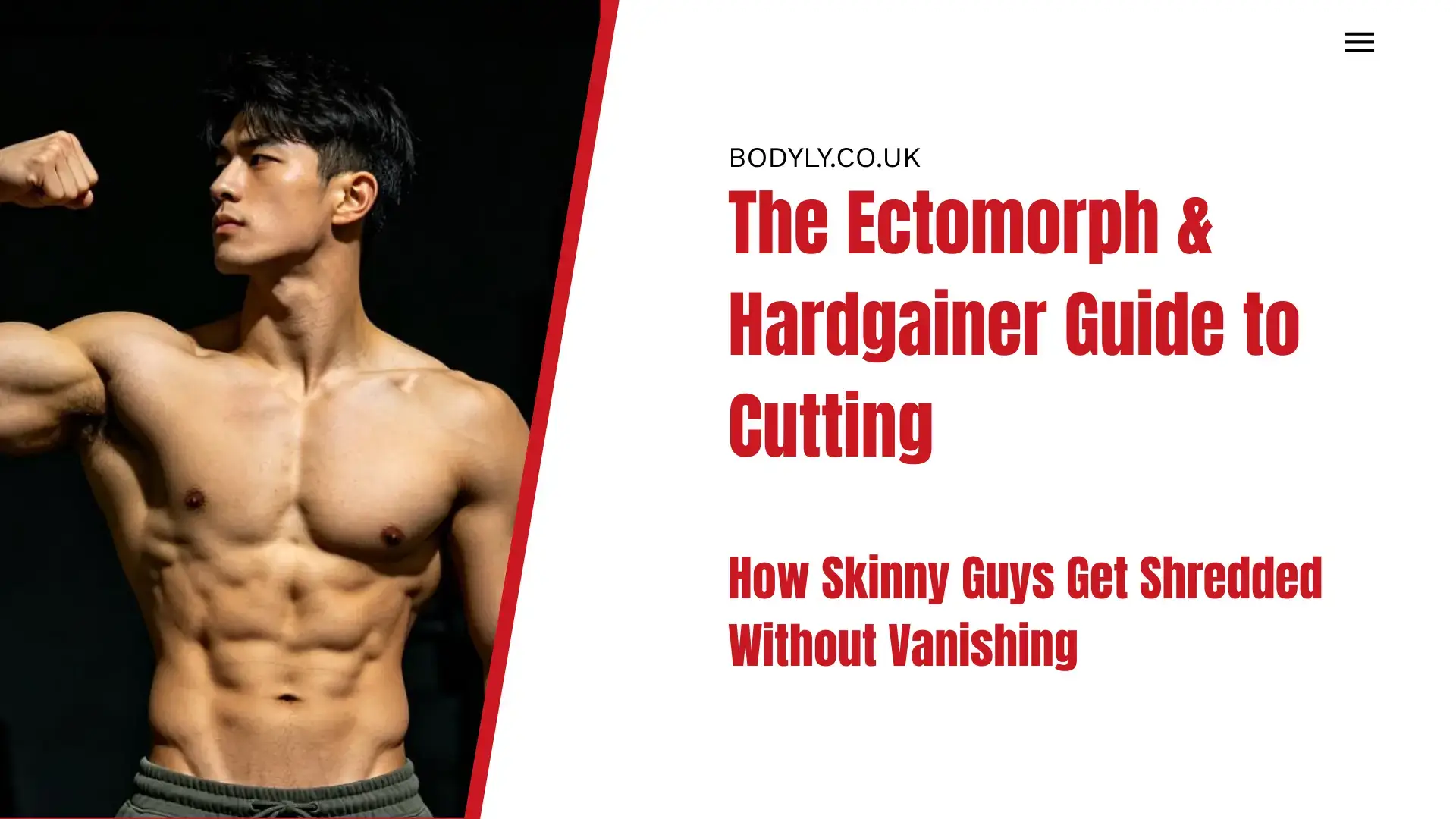
If you’re a classic ectomorph — narrow frame, fast metabolism, the guy who “can’t gain weight” — cutting is a completely different game for you than it is for everyone else. The standard advice (“big deficit, loads of cardio, grind it out”) is practically designed to make you smaller, flatter and weaker.
But here’s the thing. Done properly, a hardgainer cut can be the easiest cut in the gym — your fast metabolism finally becomes an advantage instead of a curse.
This guide covers exactly how to do it: the right deficit size, how to protect scarce muscle, why you should barely touch cardio, and a realistic UK meal approach that doesn’t require eating like a bodybuilder on prep. Let’s get into it.
First, an Honest Word About “Ectomorphs”
Let’s clear something up before we start, because we don’t do bro-science here. The somatotype system — ectomorph, mesomorph, endomorph — comes from a 1940s psychology theory that’s been scientifically discredited as a way of categorising people.
So why use the word at all? Because as gym shorthand, it describes something real: some men genuinely have narrower frames, faster metabolisms, higher NEAT (fidgeting and daily movement that burns calories), smaller appetites, and a harder time gaining weight.
If that’s you, “ectomorph” or “hardgainer” is a useful label for the practical challenge you face. Just don’t let anyone tell you it’s your genetic destiny — hardgainers build impressive physiques every single day. They just need a smarter playbook.
Wait — Why Would a Hardgainer Even Need to Cut?
Fair question. Three scenarios bring skinny guys to a cut:
The skinny-fat trap. You’re thin everywhere except a soft midsection — low muscle and stubborn belly fat at the same time. It’s frustratingly common, and we’ve written a full battle plan for it in The Skinny Fat Fix.
The post-bulk clean-up. You finally cracked the gaining code, spent eight months in a surplus, and picked up more fat than planned along the way. Now you want the muscle you built to actually show.
The definition chase. You’re at a decent weight but want visible abs and that sharp, athletic look — which for most men means getting somewhere below 12–14% body fat.
All three are legitimate. The mistake is treating any of them with a generic fat-loss plan built for men carrying three stone of spare fuel. You’re not that guy — your margins are thinner, literally.
The Golden Rule: Protect Muscle at All Costs
Everything in a hardgainer cut flows from one principle: muscle is expensive for you and cheap to lose.
A man carrying plenty of muscle and fat can diet aggressively and barely notice the muscle cost. You can’t — with less muscle in reserve and a body that’s quick to burn through tissue, a careless cut sends you straight back to skinny.
So every decision below — deficit size, training, protein, cardio, duration — is optimised for one thing: losing fat while keeping every gram of muscle you fought for. Speed comes second. It has to.
Step 1: Set a Small, Controlled Deficit
Forget the 1,000-calorie slashes you see online. Your cut lives in the 250–400 calorie deficit range — enough to lose roughly 0.25–0.5% of body weight per week, slow enough that your muscle stays put.
Finding your numbers is straightforward. Track your food intake for a week while your weight holds steady — that’s your maintenance.
Subtract 300 or so, and that’s your cutting intake. For most hardgainers, that lands somewhere between 2,200 and 2,800 calories — still a decent amount of food, which is exactly the point.
One ectomorph-specific warning: your NEAT is sneaky. Fast-metabolism guys unconsciously move more, and when you cut calories, that movement often drops without you noticing — which can stall fat loss even in a “deficit.”
The fix is simple: track your steps and keep them consistent (8,000–10,000 a day is plenty). Don’t add more; just don’t let them silently fall.
Step 2: Eat Protein Like Your Gains Depend On It (They Do)
In a deficit, protein stops being a nutrition detail and becomes your muscle-retention insurance policy. Research on lean, training individuals points to higher intakes during a cut than a bulk — aim for 2 to 2.4 grams per kilogram of body weight daily.
For a 75kg man, that’s 150–180g of protein. Every day, including rest days.
The UK shopping list writes itself: eggs, chicken thighs and breast, lean beef mince, tinned tuna and mackerel, Greek yoghurt, skyr, cottage cheese, milk, and a decent whey protein for convenience. None of it exotic, most of it cheap.
Spread it across three to five feeds of 30–50g each. And anchor breakfast with protein — it’s the meal hardgainers most often waste on cereal.
The rest of your calories split between carbs and fats, and here’s some good news: as a fast-metabolism guy, you generally tolerate carbs well. Keep them relatively high (they fuel your heavy training), keep fats moderate, and skip the keto experiments — carbs are your friend on a muscle-retention cut.
A sample day at ~2,400 calories: four eggs on two slices of wholegrain toast for breakfast; chicken, rice and vegetables for lunch; Greek yoghurt with berries and a handful of nuts mid-afternoon; lean beef mince with pasta and a side salad for dinner; and a scoop of whey in milk before bed. Nobody’s suffering on that menu.
Step 3: Train Heavy — Do Not Switch to “Toning” Mode
Here’s where most hardgainer cuts die. The instinct when cutting is to lighten the weights, raise the reps and “chase the burn” — and it’s precisely backwards.
Heavy lifting is the signal that tells your body its muscle is still needed. Remove the signal, and a body in a deficit happily burns that expensive tissue for fuel.
The prescription: keep your compound lifts — squats, deadlifts, bench, overhead press, rows, weighted pull-ups — at or near your usual working weights. Three to four sessions a week, with intensity (the load on the bar) as the thing you protect most fiercely.
What you can trim is volume. If you were doing 16 sets for chest in your bulk, 10–12 hard sets maintains muscle just fine in a deficit — recovery is tighter when calories are down, and junk volume just digs the hole deeper.
Expect the last rep or two to feel heavier some days. That’s normal in a deficit — log your lifts, and treat “weights roughly maintained” as the win it genuinely is. (And a quiet word on recovery saboteurs: regular drinking hits harder when calories are low — our look at whether alcohol lowers testosterone explains why cutting is the worst time for big weekends.)
If you’re an older hardgainer, the same rules apply with more emphasis on recovery — our guide to getting shredded after 40 covers the age-specific adjustments in full.
Step 4: The Cardio Rule — Less Than You Think
This is the section that surprises everyone. For ectomorphs, cardio during a cut should be minimal to zero.
Think about the maths. Your metabolism is already fast, your NEAT is already high, and your deficit is already set through food.
Adding three spin classes a week doesn’t accelerate fat loss — it deepens the total energy shortfall past the point your muscle can survive, spikes your appetite, and eats into recovery from the heavy lifting that’s keeping you muscular.
Your cardio prescription: daily walking (8,000–10,000 steps) and nothing else mandatory. If you genuinely enjoy a sport or a weekly five-a-side, keep it for the joy — just count it as activity and eat accordingly.
The one exception: if fat loss stalls for two-plus weeks and your food tracking is honest, add one or two easy 20–30 minute incline walks before touching your calories further. Gentle, boring, effective.
Step 5: Keep the Cut Short — Then Get Out
Hardgainers should treat cutting like a smash-and-grab, not a siege. Six to ten weeks, get the job done, leave.
Long cuts are where skinny guys go backwards: metabolism adapts, training quality erodes, and week fourteen of dieting on an already-lean frame is where muscle really starts disappearing. If you have more fat to lose than one cut allows, use mini-cuts — 6–8 weeks cutting, 4–8 weeks back at maintenance lifting hard, repeat.
And decide your exit before you start. A target waist measurement, a body-fat estimate, or simply “abs visible in normal lighting” — hit it, then deliberately return to maintenance calories over a week or two. (If the abs themselves are the goal, our guide on how to get shredded abs picks up where this one leaves off.)
The 6 Mistakes That Ruin Hardgainer Cuts
Mistake one: cutting too hard. The 1,200-calorie crash diet strips muscle from a hardgainer faster than anyone else. Small deficit, always.
Mistake two: swapping weights for cardio. The physique you’re revealing is made of muscle — abandon the barbell and there’s nothing left to reveal.
Mistake three: under-eating protein. At 1g per kg you’ll lose size; at 2g+ per kg you’ll keep it. This is the cheapest insurance in fitness.
Mistake four: cutting with nothing to cut to. If you’re simply skinny — not skinny-fat — you don’t need a cut at all; you need a proper lean bulk. Read The Skinny Fat Fix to work out which camp you’re in.
Mistake five: trusting the scales alone. On a small deficit the scale moves slowly, and daily fluctuations will gaslight you. Use weekly averages, waist measurements and progress photos.
Mistake six: the never-ending cut. Chasing “one more week” of shredding on an ectomorph frame ends with you smaller than when you started lifting. Hit the target, get out, go build.
What About Fat Burners and Supplements?
The honest answer, as always: the fundamentals above do 95% of the work, and no capsule changes that.
The short list worth considering: whey protein (convenience for hitting high protein targets — arguably the only near-essential here), creatine monohydrate (3–5g daily; well-evidenced for preserving strength and lean mass, and there’s no reason to stop it during a cut), and caffeine (training energy when calories are low — coffee works fine).
A thermogenic fat burner can add a small edge for training energy and appetite control, but it’s optional icing for a hardgainer whose deficit is already modest. If you do go down that route, choose transparent formulas with published doses and steer well clear of anything containing yohimbe or ephedra — our honest Capsiplex Burn review covers the most popular cutting-phase option for men, and our Phen24 review looks at the day-and-night alternative.


FAQs
Should ectomorphs cut or bulk first?
If you’re skinny with low muscle, bulk — you can’t reveal what isn’t there. Cut first only if you’re skinny-fat with a genuinely soft midsection, or coming off a bulk with fat to trim. When in doubt, most hardgainers benefit from building first.
How long should an ectomorph cut for?
Six to ten weeks is the sweet spot. Longer cuts on an already-lean frame progressively risk muscle loss — if there’s more fat to shift, use repeated mini-cuts with maintenance phases between them.
Will I lose muscle when cutting as a hardgainer?
Some risk always exists, but with a small deficit (250–400 kcal), high protein (2–2.4g/kg), heavy compound lifting and minimal cardio, most men retain essentially all their muscle over a short cut. The muscle loss horror stories come from aggressive deficits and abandoned barbells.
Should skinny guys do cardio while cutting?
Very little. Daily walking covers it for most ectomorphs — your fast metabolism and high NEAT already handle the energy expenditure side. Add one or two easy sessions only if fat loss genuinely stalls.
How much protein do I need on a hardgainer cut?
Aim for 2–2.4g per kilogram of body weight daily — roughly 150–180g for a 75kg man. That’s deliberately higher than bulking recommendations, because in a deficit protein is what protects your muscle.
The Verdict
A hardgainer cut done right is short, gentle and heavy: a 250–400 calorie deficit, 2g+ of protein per kilo, the big lifts kept honest, walking as your only cardio, and a firm exit date six to ten weeks out.
Do that, and your fast metabolism — the thing that made gaining so brutal — finally works for you. The fat comes off easily, the muscle stays, and for the first time you see exactly what you built.
Then comes the truly important part: getting back to maintenance and building again. Because for a hardgainer, the physique isn’t made during the cut — it’s revealed by it.
References
- NHS — Exercise and physical activity guidelines
- British Nutrition Foundation — Protein and healthy eating
- Caffeine and weight management — systematic review and meta-analysis (PubMed)
- Bodyly — The Skinny Fat Fix
- Bodyly — How to Get Shredded After 40

Tanveer Quraishi, author of Steroids 101 has extensive experience in the field of bodybuilding and has been writing online on various muscle-building and other health topics for many years now. He is not just interested in bodybuilding but is a great football player too. When he is not writing for his site or training at the gym, he loves to spend his time with this wife and kids.