The Skinny Fat Fix: How to Get Shredded When You’re Neither Fat Nor Fit (2026)
Written by Tanveer Quraishi · Fact-checked against NHS and NICE guidance · Last verified: August 2026
Key Takeaways
Slim in a shirt, soft without one. Here’s why the obvious fix makes it worse — and what actually works.
- 1 Skinny fat isn’t a fat problem. It’s a muscle problem. Normal weight, low muscle mass, fat concentrated around the middle. The scale looks fine, which is exactly why it goes unaddressed for years.
- 2 Cutting is the instinct, and it’s the wrong first move. A deficit strips the small amount of muscle you have and leaves you smaller with the same soft outline. You end up skinnier and still skinny fat.
- 3 British research proved this is real — and invisible. Imperial College London MRI scans found two men of identical BMI can carry wildly different internal fat: in one published comparison, 5.86 litres versus 1.65.
- 4 BMI is useless here, and in the UK it may mislead twice. NICE applies lower thresholds — 23 rather than 25 — for South Asian, Chinese, Black African and African-Caribbean adults, who accumulate central fat at lower body weights.
- 5 Use waist-to-height instead. NICE recommends keeping your waist under half your height. It costs nothing, takes ten seconds, and catches exactly what the scale hides.
- 6 The fix is recomposition, not weight loss. Lift three to four times a week, eat at or near maintenance with high protein, and be patient. Skinny fat is the one starting point where building comes before cutting.
Here’s the frustrating bit about being skinny fat. Nothing looks wrong enough for anyone to take it seriously.
Your weight is normal. Your BMI is fine. Nobody would call you overweight, and if you mentioned wanting to lose fat you’d probably get told you don’t need to. But you know what you look like with your shirt off, and it doesn’t match the number on the scale!
So you do the obvious thing. You cut.
And here’s the part nobody warns you about: cutting is precisely what created this problem, and doing more of it makes you a smaller version of exactly the same shape. This guide is about why that happens, and what actually works instead.
In short: to get shredded when you’re skinny fat, stop cutting and start building. Lift weights three to four times a week, eat at or slightly below maintenance with 1.6–2.2g of protein per kg of body weight, and prioritise sleep. Because you have low muscle and low training experience, you can build muscle and lose fat simultaneously — most men see a visible change in 12–16 weeks without ever running an aggressive deficit.
What Skinny Fat Actually Means
The term is gym slang, but the condition underneath it is real and has a clinical name: normal weight obesity, sometimes called metabolically obese normal weight.
It describes a body with a healthy weight, a below-average amount of muscle, and a higher-than-ideal proportion of body fat — usually concentrated around the abdomen.
Why the scale can’t see it
Muscle and fat weigh the same per kilo. They just occupy very different volumes and produce very different outlines.
Swap 8kg of muscle for 8kg of fat and your weight doesn’t move a gram. Your shape changes completely.
That’s the whole trick of skinny fat. It’s a composition problem wearing the disguise of a normal weight.
What it looks like in practice
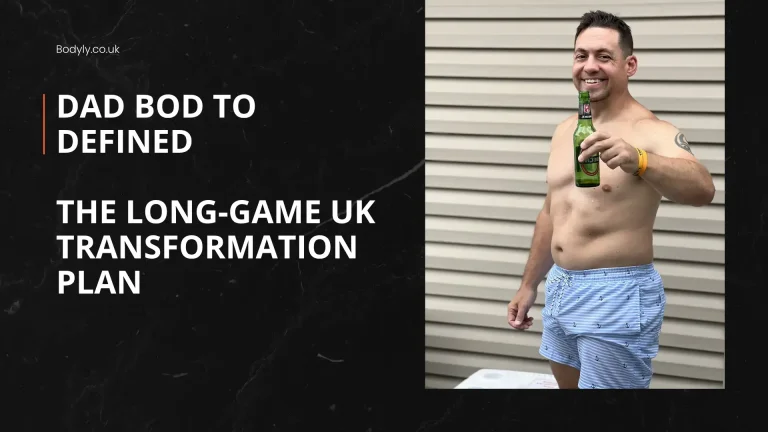
Slim in a shirt, soft without one. Narrow shoulders, a waist that doesn’t taper, and a small pouch of stubborn fat that sits low on the abdomen no matter what your weight does.
Often accompanied by decent-looking arms and legs but no visible definition anywhere. Sound familiar? That’s the shape.
The British Research That Proved It’s Real
This is the part that lifts skinny fat out of gym-bro territory, and it came from a London hospital.
Professor Jimmy Bell and his team at Imperial College London, funded by the Medical Research Council, spent years running MRI scans on hundreds of people to build what they called fat maps — images showing exactly where each person stored fat, not just how much.
What they found
Two people with the same weight, the same BMI, even the same waist measurement could have dramatically different amounts of fat wrapped around their internal organs.
In one published comparison, two 35-year-old men both had a BMI of 25. One carried 5.86 litres of internal fat. The other carried 1.65 litres.
Same number on paper. Completely different metabolic reality.
They gave it a name
Bell’s team coined the term TOFI — thin outside, fat inside. Research using this classification has estimated that around 14% of men with a BMI between 20 and 25 fall into it.
The uncomfortable detail: they found TOFI individuals among people who looked athletic, including professional models. Looking lean and being lean are genuinely different things.
Why this matters beyond the mirror
Visceral fat — the internal kind — is the metabolically active sort. It’s the type associated with insulin resistance, raised triglycerides, low HDL cholesterol and type 2 diabetes risk.
So skinny fat isn’t purely cosmetic. Bell’s research suggested people who stay slim through dieting alone, without training, are among the most likely to carry it.
That’s the mechanism in one sentence: you can diet your way to a normal weight and a poor body composition at the same time.
Two UK-Specific Tests That Beat the Bathroom Scale
American articles on this topic tell you to use BMI. In the UK, that advice is doubly unhelpful — and here’s the second reason nobody mentions.
BMI’s ethnicity problem
NICE applies lower BMI thresholds for adults of South Asian, Chinese, other Asian, Middle Eastern, Black African and African-Caribbean family background.
For these groups, increased risk begins at a BMI of 23 rather than 25, and high risk at 27.5 rather than 30. The reason is directly relevant to this article: these populations are more prone to central adiposity and carry cardiometabolic risk at lower body weights.
So if you’re a British South Asian man sitting at BMI 24 wondering why you look soft despite a “healthy” reading — the reading itself was calibrated for someone else.
The test NICE actually recommends
Here’s the useful one, and it’s free.
Keep your waist to less than half your height. That’s it. NICE recommends waist-to-height ratio alongside BMI precisely because it captures central fat, which BMI cannot.
Measure your waist at the navel, in centimetres. Divide by your height in centimetres. Under 0.5 is the target.
For a man of 175cm, that means a waist under 87.5cm. Ten seconds, a tape measure, and more information than the scale has given you in years.
The other number worth knowing
NHS guidance flags increased health risk at a waist above 94cm for men, regardless of what your BMI says.
If your BMI is normal and your waist is over that, you’ve just diagnosed yourself. That combination is close to the textbook definition of the problem.
Why Cutting Makes Skinny Fat Worse
This is the single most important section, so let’s be precise about the mechanism.
You look soft. The intuitive fix is to lose fat. So you drop calories, add cardio, and wait.
What actually happens
In a calorie deficit, your body draws on both fat and muscle. How much muscle it surrenders depends largely on two things: how hard you’re training it, and how much protein you’re eating.
Someone who’s skinny fat is starting with below-average muscle mass to begin with. There isn’t much to lose, and losing any of it is disproportionately costly.
So you finish the diet lighter — and with an even lower proportion of muscle than you started with. The outline barely changes because the outline was never about the fat alone.
The loop this creates
Weight drops. Shape doesn’t. You conclude you didn’t cut hard enough, so you cut harder next time.
Each round leaves you a little smaller and a little softer in proportion. Repeat that a few times across your twenties and thirties and you’ve engineered the exact physique you were trying to escape.
This is why crash dieting is one of the most reliable ways to create a skinny fat body, not fix one.
The thing that’s actually missing
Definition isn’t just low body fat. It’s low body fat over something.
Abs you can see require abdominal muscle to see. Shoulders that look capped require deltoids. A waist that tapers requires a back that’s wider than it.
You cannot reveal a shape that isn’t there yet. That’s the whole problem, and no amount of dieting solves it.
The Recomposition Window You Actually Have
Now the good news, and it’s genuinely good.
Building muscle and losing fat at the same time — body recomposition — is difficult for a trained lifter. For someone who’s skinny fat, it’s the easiest it will ever be.
Why you’re in the ideal position for it
Recomposition works best in people who are new to lifting, returning after a long break, or carrying more fat than muscle. Skinny fat usually ticks at least two of those boxes.
You have untrained muscle that responds quickly to a novel stimulus, and stored body fat available as fuel. That’s precisely the situation where both can happen at once.
What that means practically
You don’t need to bulk. You don’t need an aggressive cut. You need to eat at or slightly below maintenance, train hard, and get enough protein.
The scale will barely move for months. This is not failure — it’s the entire point. Fat leaving and muscle arriving at similar rates is exactly what a successful recomp looks like on a set of scales.
Which is why you should stop weighing yourself as your primary measure and start using photos, waist measurements and gym numbers instead.
The Fix: What to Actually Do
Here’s the framework in the order it matters.
1. Lift three to four times a week — this is the priority
Not cardio. Not abs. Resistance training with progressive overload, built around compound movements: squats, hinges, presses, rows and pull-ups.
Full-body three times a week or an upper/lower split four times works well. Every muscle group trained at least twice weekly.
The programming here is the same one we lay out in our complete guide to getting shredded after 40 — the training principles don’t change with body type, only the calorie strategy does.
2. Prioritise the back and shoulders specifically
A tapered waist is mostly an illusion created by the width above it. Rows, pull-ups, lateral raises and face pulls do more for how lean you look than any ab exercise.
Skinny fat physiques are almost always underdeveloped through the upper back. Fix that and the same waist reads as narrower.
3. Eat at maintenance, not in a deficit
Calculate maintenance and eat there — or at most 200 calories below. Resist the urge to go lower.
You’re not trying to lose weight quickly. You’re trying to change what your weight is made of, and that requires enough fuel to build with.
4. Get protein genuinely right
1.6–2.2g per kilogram of body weight, daily. For an 80kg man that’s 130–175g, and most people in this situation are eating half that.
Protein is the non-negotiable variable in recomposition. Anchor every meal around a source — eggs, chicken, lean mince, Greek yoghurt, skyr, cottage cheese, tinned fish, or a decent whey.
5. Keep cardio moderate
Two or three easy sessions a week plus a daily step target of 8,000–10,000. That’s enough for heart health and visceral fat without competing with your recovery.
Excessive cardio is a common cause of skinny fat in the first place. Don’t reach for more of the thing that helped create it.
6. Protect sleep and manage stress
Seven to nine hours. Poor sleep raises cortisol, and elevated cortisol encourages fat storage around the middle — the exact region you’re trying to change.
The mechanism is worth understanding properly, and we’ve covered it in detail in cortisol and belly fat in men. Stubborn abdominal fat in an otherwise slim man is often as much a stress and sleep problem as a diet one.
7. Give it 12 to 16 weeks before judging anything
Recomposition is slower than cutting and less dramatic week to week. It’s also the only approach that produces the shape you actually want.
Take photos at week zero. Don’t look at them again until week eight.
When to Cut Instead
One exception, because the advice above isn’t universal.
If your waist-to-height ratio is meaningfully above 0.5 — say 0.55 or higher — you’re carrying enough fat that a modest deficit alongside your training makes sense.
Even then, keep it gentle: 300–400 calories below maintenance, protein high, lifting unchanged. The goal is still to protect the muscle you’re building.
And once you’re near 0.5, switch back to maintenance and keep training. Don’t chase leanness for its own sake — men who keep cutting past this point are usually the ones who end up back where they started.
There’s one more thing worth ruling out. If you’re carrying stubborn abdominal fat despite doing everything right, low testosterone and its knock-on effects can be part of the picture — we cover that in does testosterone help you burn fat and oestrogen and belly fat in men.
A Word on Supplements
Brief, because the honest answer is short.
Creatine and protein powder are the two worth your money here. Creatine supports strength and muscle gain, which is the entire objective; protein powder simply makes the target easier to hit.
Vitamin D through the British winter, per NHS guidance, since October to March sunlight isn’t strong enough for your body to produce it.
Fat burners are the wrong tool for this specific problem. They’re built to support a calorie deficit, and a deficit is precisely what you’re trying to avoid. If you later find yourself genuinely cutting, our best fat burners for men in the UK rankings are there — but for a skinny fat starting point, that money is better spent on food and a gym membership.
⚖️ Fat Burners: Only If You’re in the Cut-First Group
Matched to the sticking point that actually stalls a deficit — appetite, energy, or evening cravings
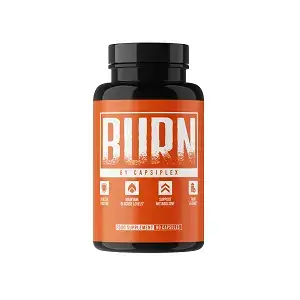
Capsiplex Burn
- Best pick if low-calorie training days flatten you — and protecting session quality is what protects your muscle
- Caffeine and Capsimax both clinically dosed, full formula published
- Too much stimulant if your sleep is already shaky

Phen24
- Built for the 9pm snacking that undoes most deficits — the caffeine-free night capsule targets it directly
- Both formulas published openly, and sleep-friendly by design
- Pricier two-part system with a long exclusion list

PhenQ
- The no-overthinking option — two capsules a day from an established UK maker
- Capsimax and caffeine core properly dosed
- Several supporting actives sit below the doses in the studies cited

CalmLean
- The right tool if you train after work or stimulants wreck your sleep — and sleep is where recomposition is won
- Simple four-ingredient formula, 67-day guarantee
- ForsLean dose isn’t published, and forskolin evidence is mixed
The Bottom Line
Skinny fat feels like a fat problem, which is why almost everyone attacks it as one and gets nowhere.
It’s a muscle problem. The fat is only visible because there’s so little underneath it, and every round of dieting removes a bit more of the thing that would have fixed it.
The escape is unintuitive but simple: stop trying to get smaller. Lift three or four times a week, eat enough protein at roughly maintenance, walk daily, sleep properly, and let 12 to 16 weeks pass without weighing yourself into a panic.
Measure your waist against half your height instead. That single number will tell you more than the scale ever did.
And the encouraging part — you’re in the one starting position where muscle gain and fat loss happen simultaneously. That window doesn’t stay open forever. Use it.
FAQs
Should I bulk or cut if I’m skinny fat?
Neither, in most cases. Because you have low muscle mass and limited training experience, you’re well placed to build muscle and lose fat simultaneously by eating at or slightly below maintenance with high protein while lifting three to four times a week. Only consider a modest deficit if your waist-to-height ratio is meaningfully above 0.5.
How long does it take to fix a skinny fat body?
Expect a visible change in 12 to 16 weeks and a substantial one in 6 to 12 months. Recomposition is slower than straightforward fat loss because two things are happening at once, and your weight may barely move throughout — which is why photos, waist measurements and gym performance are far better progress markers than the scale.
How do I know if I’m skinny fat rather than just slim?
Measure your waist at the navel and divide it by your height. NICE recommends keeping this ratio under 0.5, so a normal BMI combined with a ratio above that suggests low muscle and central fat. NHS guidance also flags a waist above 94cm in men as an increased health risk regardless of BMI.
Can I fix skinny fat with cardio and diet alone?
No — and that combination is the most common cause of it. Dieting without resistance training removes muscle alongside fat, so you become a smaller version of the same shape. Resistance training is the non-negotiable part; cardio is useful for health and a modest calorie contribution, but it doesn’t build the muscle that creates definition.
References
- Thomas EL, Frost G, Taylor-Robinson SD, Bell JD. Excess body fat in obese and normal-weight subjects. Nutrition Research Reviews, Cambridge Core.
- NICE: Keep the size of your waist to less than half of your height
- NHS Digital: Overweight and obesity — ethnicity and health, including NICE BMI thresholds
- Physical activity guidelines for adults aged 19 to 64 — NHS
- Vitamin D — NHS
- TOFI phenotype and its effect on the occurrence of diabetes — PubMed
This article is for information only and is not medical advice. If you have concerns about your weight, body composition or metabolic health, speak to your GP — and if you’re 40 to 74 in England, you’re entitled to a free NHS Health Check.

Tanveer Quraishi, author of Steroids 101 has extensive experience in the field of bodybuilding and has been writing online on various muscle-building and other health topics for many years now. He is not just interested in bodybuilding but is a great football player too. When he is not writing for his site or training at the gym, he loves to spend his time with this wife and kids.