
Testosterone and Sexual Health in UK Men: Low T, Libido, Erectile Dysfunction & Fertility
Let’s start with a number that stops most men in their tracks: testosterone levels in men have been falling by roughly 1% a year for decades, meaning the average UK man today has less of it than his father did at the same age. That’s not a scare stat — it’s a well-documented population trend, and it shows up in the bedroom before it shows up anywhere else.
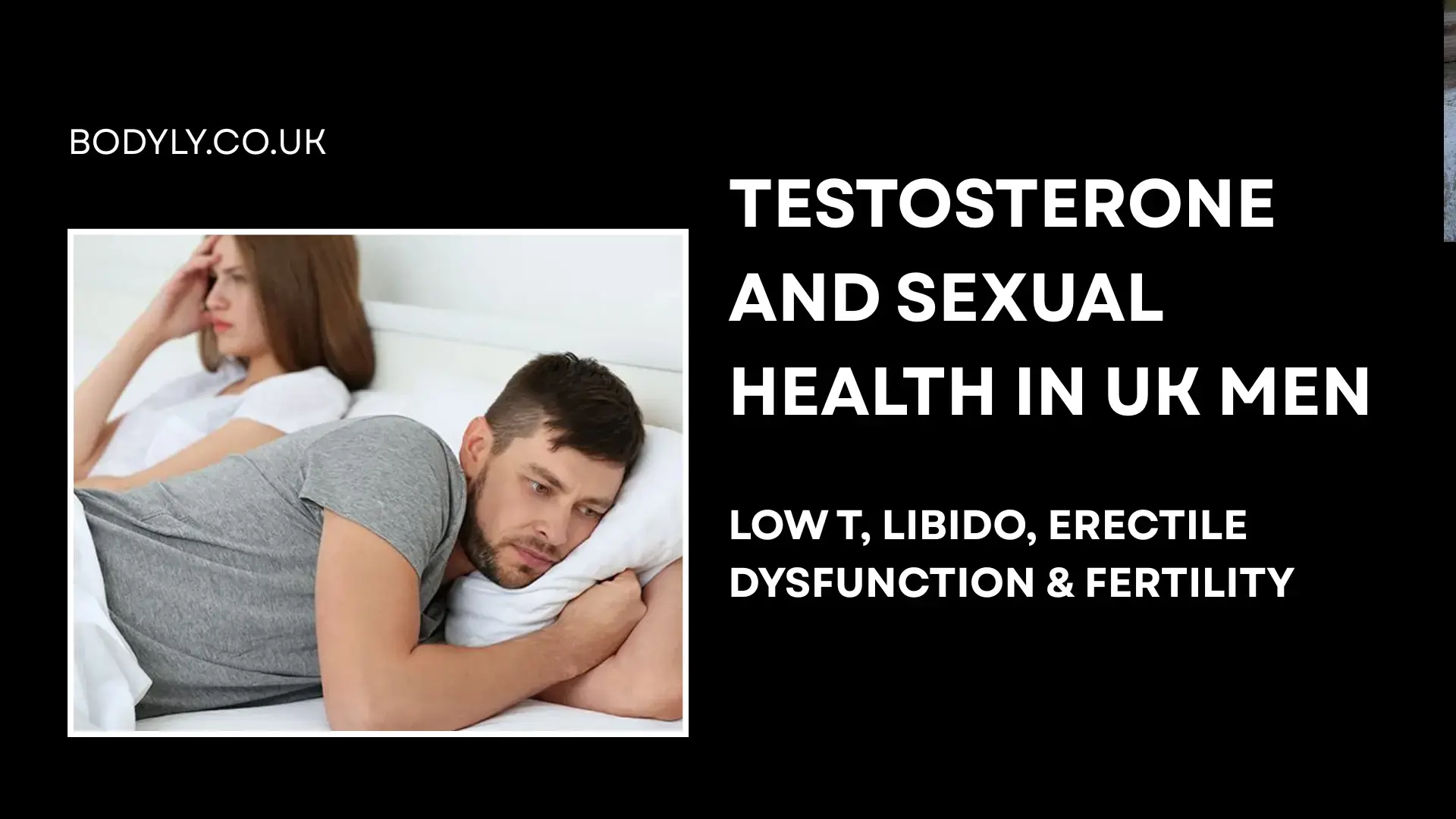
Here’s the thing I want you to understand up front. Low testosterone — “low T” — isn’t just about feeling tired or losing muscle. It sits right at the centre of male sexual health, quietly shaping your libido, your erections, and even your fertility. And yet so many men suffer in silence, chalking it up to stress, age, or “just getting older.”
But is it really just age? Sometimes. Often, it’s not.
In this guide I’ll walk you through exactly how testosterone connects to sex drive, erectile function and sperm production, what actually causes low T in UK men, how it’s diagnosed on the NHS and privately, and the part everyone wants — what you can genuinely do about it, from lifestyle changes to TRT. No hype, no miracle cures. Just what the evidence says.
What Is Testosterone and Why Does It Matter for Men’s Sexual Health?
Testosterone is your body’s primary male sex hormone, and the vast majority of it is made in the testicles under instruction from your brain. Think of it as the master switch behind everything from your beard to your bedroom performance.
Not all of it is usable, though. Your total testosterone is the full amount in your blood, but your free testosterone — the small fraction floating around unbound — is what actually reaches your tissues and drives how you feel.
That distinction matters because of a protein called SHBG, or sex hormone binding globulin. SHBG grabs onto testosterone and locks it away, so you can have a “normal” total reading while your free, active testosterone is quietly running low.
This is why testosterone touches so much at once. The same hormone regulating your libido is also governing your erections, your sperm production, your muscle mass, and your mood — which is why low T rarely announces itself with a single symptom.
UK labs will usually flag anything below roughly 12 nmol/L as low, with a “grey zone” beneath that. But here’s the nuance most men miss: sitting at the bottom of the normal range isn’t the same as being at your personal optimum, and symptoms matter as much as numbers.
For a deeper dive, see our guides on SHBG and Testosterone in UK Men and Testosterone and Bodybuilding in the UK.
Recognising the Symptoms of Low Testosterone (Low T)
| Category | Common Symptoms |
|---|---|
| Sexual | Reduced libido, weaker or less frequent erections, loss of morning erections, low sperm count |
| Physical | Fatigue, loss of muscle mass, increased body fat, reduced strength, low bone density |
| Psychological | Low mood, irritability, brain fog, poor concentration, reduced motivation and drive |
The sexual symptoms are usually the first to show. A fading interest in sex, weaker or less frequent erections, and the quiet disappearance of your morning erections are all classic early signals.
Then come the physical changes. Persistent fatigue, muscle that’s harder to build and easier to lose, creeping belly fat, and a general drop in strength often creep in so gradually that you adapt without noticing.
The psychological side is just as real, if easier to dismiss. Low mood, irritability, brain fog and a flatness of motivation can all trace back to declining testosterone rather than to life simply “getting on top of you.”
The tricky part is the overlap. These exact symptoms also describe stress, depression and an underactive thyroid, which is precisely why low T is so often missed or misattributed for years.
So use this as a prompt, not a diagnosis. If several of these ring true at once — especially the sexual ones alongside the fatigue — that’s a strong reason to ask your GP for a proper blood test rather than guessing.
Does Low Testosterone Affect Mood and Mental Health?
Absolutely — and it’s one of the most overlooked effects. Low testosterone is linked to low mood, irritability, poor concentration and reduced motivation, and these can appear before the physical symptoms do.
The catch is the overlap with depression itself. Because the symptoms mirror each other so closely, it’s worth checking your testosterone if low mood arrives alongside fatigue and a flagging sex drive — the two are often tangled together.
Is Low Testosterone the Same as the “Male Menopause”?
You’ll often hear low T called the “male menopause” or “andropause,” but the label is a bit misleading. Unlike the female menopause, there’s no sudden shutdown — men experience a gradual, uneven decline rather than a hard stop.
That’s an important distinction for how it’s treated. Because the change is slow and variable, diagnosis relies on your symptoms and a blood test, not simply your age.
Low Testosterone and Libido: The Sex Drive Connection
Desire starts in the brain, and testosterone is one of its main fuels. It acts on the areas that govern sexual interest, which is why a genuine testosterone shortfall tends to dull wanting sex in the first place.
For a lot of men, this is the very first domino to fall. Libido often dips before erections become an obvious problem, making a sudden loss of interest one of the earliest and most telling signs of low T.
It’s worth being clear about a distinction here. Low desire and difficulty getting an erection are not the same thing — you can have plenty of one and struggle with the other — and untangling which is which points to very different causes.
Testosterone isn’t the only libido killer, either. Chronic stress, broken sleep, relationship strain and common medications (including some antidepressants) can flatten your sex drive while your hormones sit perfectly normal.
The practical rule: when low desire lingers for weeks and comes bundled with fatigue or mood changes, that combination earns a testosterone test rather than a shrug.
Testosterone and Erectile Dysfunction (ED): What’s the Link?
An erection is really a plumbing event. It depends on healthy blood flow and a molecule called nitric oxide relaxing the vessels, with testosterone working in the background to keep that whole system primed.
That background role is key. Low testosterone can absolutely contribute to erectile dysfunction, but it’s rarely the sole villain — the wiring and the blood supply usually matter more than the hormone alone.
This is where ED becomes genuinely important as a warning sign. Because erections rely on good circulation, difficulty here can be the earliest visible clue of vascular problems like heart disease, diabetes or high blood pressure.
It also explains why the famous pills aren’t a cure-all. PDE5 inhibitors such as sildenafil (Viagra) and tadalafil (Cialis) improve blood flow on demand, but they do nothing to fix an underlying testosterone deficiency.
So treat persistent ED as a full-body check, not just a bedroom inconvenience. It’s a sensible trigger to have both your testosterone and your cardiovascular health assessed properly.
Testosterone, Sperm and Male Fertility
Making sperm is a team effort between hormones. Testosterone inside the testicles matters, but it works alongside two brain signals — FSH and LH — that actually drive sperm production.
Now for the paradox that catches men out. Taking testosterone from outside the body (TRT) tells the brain to stop sending those signals, which can shrink the testicles and slash sperm count — the opposite of what you’d expect.
This is why timing is everything if you want children. Men who are trying to conceive should be cautious about starting TRT and instead discuss fertility-friendly alternatives such as hCG or clomiphene with a specialist.
Lifestyle plays a bigger role than most realise, too. Excess heat, smoking, heavy drinking and carrying too much body fat all degrade sperm quality, often quietly and reversibly.
If conception isn’t happening after a year of trying — or six months if your partner is over 35 — that’s the point to see a fertility specialist. A simple semen analysis is usually the first, painless step.
What Causes Low Testosterone in UK Men?
Age is the obvious factor, but it’s not the whole answer. Testosterone naturally drifts down from your thirties in what’s called late-onset hypogonadism, yet plenty of “age-related” cases actually have a fixable cause underneath.
Doctors split the problem in two. Primary hypogonadism means the testicles themselves are underperforming, while secondary means the brain isn’t sending the right signals — and the treatment differs depending on which it is.
For most UK men, lifestyle is the biggest lever. Carrying excess weight, sleeping badly, living under chronic stress, drinking heavily and sitting all day each drag testosterone down, and they tend to gang up together.
Medical conditions account for another slice. Type 2 diabetes, metabolic syndrome, pituitary problems and certain medications can all suppress your levels, which is why bloods should look at the wider picture.
Then there’s the population-wide decline that opened this article. Diet, obesity rates and environmental factors are all suspected contributors to why each generation seems to test lower than the last.
Related reading: Oestrogen Dominance in Men UK and Testosterone Levels in Your 40s in the UK.
How Long Does It Take to Recover Testosterone After Stopping Steroids?
Anabolic steroid use is a common but often unspoken cause of low testosterone in younger men. Because external steroids switch off your own production, levels can stay suppressed for months after you stop.
Recovery time varies widely — some men bounce back within a few months, while others struggle for a year or more, and a minority never fully recover without help. This is one reason we always steer readers toward legal, non-suppressive alternatives rather than anabolic steroids.
Related: our guides on post-cycle recovery and bulking steroids in the UK.
At What Age Does Testosterone Start to Drop in Men?
For most men, testosterone begins its slow decline from around the age of 30. The average fall is roughly 1–2% a year, which sounds small but compounds quietly over decades.
Here’s a nuance the headlines miss, though. Some research suggests average total testosterone is fairly stable in healthy men after 40 — what really changes is the variation between individuals, and a steeper drop in usable free testosterone as SHBG rises with age.
So age matters, but it isn’t destiny. A healthy 60-year-old can easily out-test an unhealthy 35-year-old, because lifestyle and body fat often influence your levels more than the birthday on your passport.
How Low Testosterone Is Diagnosed in the UK
Timing your test correctly is non-negotiable. Testosterone peaks in the morning, so a reliable reading needs a blood sample taken before around 11am, ideally on two separate days.
A single number isn’t enough, either. A proper panel should include total and free testosterone plus SHBG, LH, FSH, prolactin and oestradiol, because those extras reveal why your level is low.
You have two routes to get tested. The NHS will investigate when symptoms and a low reading line up, while private men’s health clinics offer faster, more comprehensive panels for those who want them.
Interpreting the results is where a good clinician earns their keep. Reference ranges are broad and population-based, so a “normal” figure paired with clear symptoms still deserves a proper conversation rather than a dismissal.
Go in prepared. Ask what your free testosterone and SHBG actually are, how your symptoms fit the numbers, and whether a repeat or referral makes sense.
Treatment Options — From Lifestyle to TRT
The first prescription is almost always lifestyle. Losing excess fat, lifting weights, fixing your sleep and cutting back on alcohol can meaningfully lift testosterone, and for many men this alone resolves the symptoms.
| Option | Best For | Prescription? | Fertility-Safe? |
|---|---|---|---|
| Lifestyle changes Sleep, training, weight loss, less alcohol |
Everyone — the essential first step | No | Yes |
| Natural support supplements e.g. Testo Prime |
Healthy men optimising alongside good habits | No | Yes |
| TRT Gels or injections |
Confirmed, symptomatic clinical deficiency | Yes | No — can reduce it |
| hCG / clomiphene Fertility-sparing options |
Men with low T who want to conceive | Yes | Yes |
When lifestyle isn’t enough, there’s TRT. Testosterone Replacement Therapy — delivered as gels or injections — can be transformative for men with genuine, confirmed deficiency, and the NHS prescribes it where criteria are met.
But TRT is a serious commitment, not a quick win. It carries real considerations around fertility, cardiovascular health and the prostate, all of which need weighing up with a doctor before you start.
It’s also usually for life. Once you begin, your body typically winds down its own production, so this is a long-term therapy that demands ongoing blood monitoring and medical supervision.
That supervision is the whole point. Self-sourcing testosterone online skips the safety checks that make treatment work — proper diagnosis, correct dosing and regular monitoring are what separate a genuine fix from a gamble.
Can Low Testosterone Be Cured?
It depends on the cause. Where low T is driven by lifestyle — weight, sleep, stress, alcohol — it can often be genuinely reversed by tackling those factors, which is the best-case scenario.
Where there’s a medical cause, it’s usually managed rather than cured. TRT can restore levels effectively, but it’s typically a long-term therapy rather than a one-off fix, which is why getting the diagnosis right comes first.
How to Naturally Support Healthy Testosterone Levels
Exercise is your strongest natural lever. Resistance training and high-intensity work both nudge testosterone upward, while regular movement helps by stripping away the body fat that suppresses it.
Nutrition lays the foundation. Your body can’t make testosterone well without enough zinc, vitamin D, magnesium and healthy fats, and quietly running short on any of these can hold your levels back.
Never underestimate sleep. Most of your daily testosterone is produced while you sleep, so chronic short or broken nights are one of the fastest ways to tank your levels — and one of the easiest to fix.
Managing body fat does double duty. Excess fat converts testosterone into oestrogen, so losing it both raises your testosterone and lowers the oestrogen working against you.
This is also where a well-formulated supplement can support the process. Natural testosterone boosters won’t rewrite your biology, but the right one can top up the nutrients your body relies on and complement the lifestyle work above.
Two I’d point UK men toward are Testo Prime and its newer sibling Testo Prime Gold. Both are legal, over-the-counter, all-natural formulas — not steroids and not TRT — built around evidence-linked ingredients like vitamin D, zinc and D-aspartic acid to support your natural testosterone production, energy and libido.
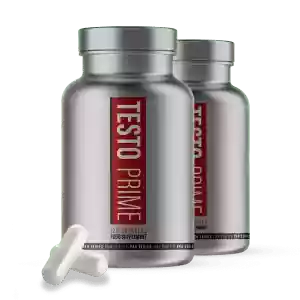
- Legal in the UK — no prescription needed
- Not a steroid and not TRT — 100% natural formula
- Supports your body’s own testosterone production
- Includes vitamin D, zinc & D-aspartic acid
- Formulated to support energy & stamina
- May help support libido and drive
- No known serious side effects
- No PCT required
- Lifetime money-back guarantee
To set honest expectations: these are support supplements, not medicines. They can’t treat clinically diagnosed hypogonadism, cure erectile dysfunction or replace medical care — but for a generally healthy man looking to optimise, they’re a safe, side-effect-friendly way to back up good habits.
Testo Prime Gold is the step-up formula, aimed at older men or those wanting a more comprehensive blend, while standard Testo Prime suits most people starting out. Both come with a money-back guarantee, which takes the risk out of trying them.
Read our full, unfiltered Testo Prime review before you buy.
Can You Increase Testosterone Naturally at Any Age?
Yes — and the levers work at any age, though the ceiling gets a little lower as you get older. Losing excess body fat, lifting weights, sleeping properly and cutting back on alcohol all reliably nudge testosterone upward.
The biggest single win for many men is simply losing weight. Excess fat both lowers testosterone and converts it into oestrogen, so shedding it can break that cycle from both ends.
What natural methods can’t do is override a genuine medical cause. If your levels are low because of a pituitary or testicular problem, lifestyle helps your overall health but won’t fix the underlying issue — which is exactly why testing matters.
When to See a Doctor About Testosterone and Sexual Health
Some symptoms shouldn’t wait. Persistent erectile difficulty or a sudden, unexplained loss of libido are red flags that deserve a professional opinion rather than months of quiet worry.
Remember the heart connection. ED can act as an early warning of cardiovascular disease, so getting it checked can catch a bigger problem long before it becomes dangerous.
Know what to expect so nerves don’t stop you. A men’s health or urology appointment typically means a straightforward chat, some blood tests and a physical check — nothing to dread.
Above all, normalise the conversation. The men who get help early get the best outcomes, and there is genuinely nothing to be embarrassed about in looking after your own health.
Conclusion
So where does this leave you? Testosterone isn’t the whole story of men’s sexual health — but it’s a bigger chapter than most men realise. Low T can quietly drain your libido, undermine your erections, and complicate your fertility, and far too often it gets brushed aside as “just age.”
Here’s my honest takeaway. Your symptoms are real, they’re usually treatable, and they’re frequently a window into your wider health — especially your heart. That low sex drive or stubborn erectile issue might be the nudge that gets you to sort out your sleep, your waistline, and your bloods before something more serious shows up.
The good news? A lot is within your control. Lifestyle changes move the needle more than most men expect, natural support like Testo Prime can back up those habits, and where they’re not enough, proper medical treatment — done under supervision — can be genuinely life-changing.
Don’t sit on it. If any of this sounds familiar, book a morning blood test, talk to your GP or a men’s health clinic, and get a clear picture of what’s actually going on. Your future self will thank you.
Want to go deeper on optimising your hormones naturally? Read our full guide to Testosterone and Bodybuilding in the UK next.
Frequently Asked Questions
Can low testosterone cause erectile dysfunction?
It can contribute, but it’s rarely the only cause — most ED involves blood flow and vascular health as well. That’s why low T and ED should both be assessed properly rather than treated with pills alone.
What’s a normal testosterone level for a UK man?
UK labs generally treat total testosterone between roughly 10 and 30 nmol/L as normal, with anything under about 12 nmol/L often flagged as low. Symptoms matter alongside the number, since a “normal” reading can still leave you below your personal optimum.
Does TRT affect fertility?
Yes — testosterone replacement therapy can suppress sperm production and lower fertility, sometimes significantly. Men who want children should discuss fertility-sparing options like hCG or clomiphene with a specialist before starting TRT.
Do natural testosterone boosters actually work?
Well-formulated ones can support your natural production by supplying nutrients like vitamin D, zinc and magnesium, and may help energy and libido in generally healthy men. They can’t treat diagnosed hypogonadism or replace medical care, so treat them as support for good habits rather than a cure.
References
- Low testosterone (male hypogonadism) — Cleveland Clinic
- Erectile dysfunction — NHS inform
- Hypogonadism in the aging male: diagnosis, benefits and risks of TRT — International Journal of Endocrinology
- Low free testosterone and hypogonadal symptoms with normal total T — European Male Ageing Study
- Low testosterone in adolescents and young adults (fertility and TRT considerations)
- Erectile dysfunction FAQs — Cambridge University Hospitals NHS
This article is for general information and is not medical advice. Always consult a GP or qualified clinician about your own symptoms. Contains affiliate links; we may earn a commission if you purchase through them, at no extra cost to you.

Tanveer Quraishi, author of Steroids 101 has extensive experience in the field of bodybuilding and has been writing online on various muscle-building and other health topics for many years now. He is not just interested in bodybuilding but is a great football player too. When he is not writing for his site or training at the gym, he loves to spend his time with this wife and kids.
