
How Long Does Clenbuterol Stay in Your System?
How long does clenbuterol stay in your system? Two different answers, and confusing them is where people go wrong. The plasma half-life in humans is roughly 35 hours, so the drug itself is largely cleared within about a week. But detection lasts far longer: a controlled study of healthy men given a single 80 µg dose found it detectable in urine for at least 7–10 days, in dried blood spots for around three days, and hair testing can reach back months. The effects stop long before the test does.
This question gets asked for two very different reasons, and most pages answer only one of them.
Some people want to know how long the effects last, or how long before a dose accumulates dangerously. Others want to know how long a test can find it. Those are separate numbers governed by separate things, and the gap between them is the most useful thing on this page.
The Half-Life: What the Human Data Says
Most pages on this topic quote a half-life figure without saying where it came from, and the numbers vary wildly as a result — anything from 26 to 48 hours depending on which forum post got copied.
The primary human source is a study in which healthy volunteers were given therapeutic oral doses of 20, 40 and 80 µg, with plasma and urine measured by enzyme immunoassay.
Thirty-five hours is the number worth remembering, and it explains a great deal about how this compound behaves.
The Clearance Curve: What 35 Hours Actually Means
A half-life is the time taken for blood concentration to fall by half. That sounds simple until you try to work out when a drug is actually gone, so here it is as a table rather than as arithmetic.
| Time since last dose | Half-lives elapsed | Roughly what remains |
|---|---|---|
| 35 hours (~1.5 days) | 1 | 50% — still substantially present. Effects usually ongoing. |
| 70 hours (~3 days) | 2 | 25% — tremor and sleep disruption often easing by now. |
| 105 hours (~4.5 days) | 3 | 12.5% — most people would describe themselves as back to normal. |
| 140 hours (~6 days) | 4 | 6.25% — conventionally treated as substantially cleared. |
| 175 hours (~7 days) | 5 | ~3% — negligible pharmacologically. Still detectable in urine. |
Based on a plasma half-life of approximately 35 hours from human volunteer data. Individual clearance varies with kidney function, dose, duration of use and other medications.
The two things this table shows
First, the drug takes roughly six to seven days to leave your bloodstream in any meaningful sense. Compare that with caffeine at around five hours, where five half-lives is finished before lunch the next day.
Second, and more importantly: the last row still says detectable. At day seven, roughly 3% of the compound remains — pharmacologically negligible, and comfortably within range of an assay designed to find parts per billion.
That single row is the whole article. Gone and undetectable are not the same state, and they’re separated by days.
Why Every Site Gives a Different Number
Search this question and you’ll be told the half-life is 26 hours, or 35, or 39, or 48 — often on pages that cite nothing. Those numbers aren’t invented. They come from different studies, in different species, measuring different things.
Here’s where each one actually originates, which is worth knowing before you trust any page quoting one.
| Figure you’ll see | Where it comes from | Applies to humans? |
|---|---|---|
| ~26 hours | Rat pharmacokinetic work — the slower phase of a biphasic elimination | No — rodent data |
| ~35 hours | Human volunteers, oral therapeutic doses, plasma measured by enzyme immunoassay [1] | Yes — use this one |
| ~48 hours | Equine study — the slower phase of urinary elimination in horses [9] | No — horses, and urine not plasma |
| “39 hours” | Typically an upper bound quoted from secondary sources without a primary citation | Plausible range, unsourced |
The two mistakes behind the confusion
Species substitution. Clenbuterol is far better studied in animals than in people, because it’s a veterinary medicine and a livestock contaminant. Rodent and equine figures are easier to find, and they get repeated as though they were human data.
Matrix substitution. A plasma half-life and a urinary elimination half-life measure different things. The equine study found urinary half-lives of roughly 12 and 48 hours in a biphasic pattern — quoting the 48 as “clenbuterol’s half-life” conflates a urine excretion phase with blood clearance.
The figure to use for a person is the human plasma one: approximately 35 hours. Everything else on this page follows from it.
Why it’s so much longer than similar drugs
Clenbuterol resists first-pass metabolism in the liver far better than related beta-2 agonists like salbutamol. More of each dose survives into circulation and stays there, which is precisely why it was developed as a long-acting bronchodilator.
Elimination happens predominantly through the kidneys. That’s a detail with practical consequences — anyone with reduced kidney function clears it more slowly, and every window on this page stretches accordingly.
The Accumulation Problem
This is the part of the pharmacology that matters most for safety, and it follows directly from the half-life.
In the human study above, twice-daily dosing produced a plasma plateau only after around four days [1]. Levels were still climbing across that period because each dose arrived while the previous ones were substantially present.
It also explains a common misreading of tolerance. The 2025 randomised trial found beta-2 receptors desensitising within a two-week cycle, so the fading effect people describe is real — but the compound in the bloodstream is going up while the response goes down.
Which makes raising the dose the worst available response: more drug, more cardiac exposure, less effect. Our breakdown of what results actually look like covers that trial in full.
Detection Windows: A Different Clock Entirely
Here’s where most articles go wrong. They quote the half-life and then imply that once the drug has cleared, a test won’t find it.
That isn’t how detection works. Modern anti-doping analysis operates at concentrations far below anything pharmacologically active, so a test finds traces long after the last effect has faded.
Note the design: that’s one dose. A cycle of repeated dosing produces higher concentrations and a longer tail, so real-world windows extend beyond what a single-dose study can measure.
Why Urine Detection Outlasts Blood Clearance
The obvious question after the two studies above: if the drug is essentially gone from blood in a week, how is urine still positive at day ten?
Three mechanisms, and understanding them explains most of what’s confusing about this subject.
1. Urine is a concentrate, not a snapshot
Blood measures what’s circulating right now. Urine measures what the kidneys have been removing, concentrated by the bladder over hours.
Since elimination is predominantly renal, urine is where the compound is being actively deposited — so concentrations there stay measurable long after plasma levels have fallen away.
2. Assays look for metabolites too
Detection methods don’t only target the parent compound. Metabolites persist on their own timelines, and a positive test can rest on breakdown products rather than on clenbuterol itself.
This is a general principle of drug testing rather than something particular to this compound, and it’s a large part of why detection windows so consistently outrun clearance estimates.
3. The sensitivity gap is enormous
This is the biggest factor, and the one people underestimate most.
Pharmacological effect requires a meaningful concentration. Modern LC–MS/MS analysis detects at parts per billion — and in the meat contamination cases, at picogram levels from residues in a meal.
And why hair is different again
Hair doesn’t measure clearance at all. Compounds are incorporated into the growing shaft, so a hair sample records a history rather than a current state — which is why segmental analysis can reconstruct exposure month by month, and why reported windows run to months rather than days.
| Sample type | Typical detection window | Notes |
|---|---|---|
| Blood / dried blood spot | Around 3 days | All subjects positive at 24 hours; half still positive at 72 hours after a single dose |
| Urine | At least 7–10 days | The standard doping-control matrix. Longer after repeated dosing |
| Hair | Reported at months | Used for retrospective investigation rather than routine screening |
| Standard hospital tox screen | Not detected | Requires specific analysis — tell clinicians directly if you need care |
These are typical ranges from published research. Individual windows vary with dose, duration of use, kidney function, hydration and the sensitivity of the specific assay used.
The 5 ng/mL Threshold and Why It Exists
This is the detail that separates a useful article on this subject from a rewritten forum post, and it produces a genuinely counterintuitive result.
In 2019 WADA introduced a minimum reporting level for clenbuterol of 5 ng/mL. Below that concentration, a finding isn’t reported as a violation — a rule introduced because clenbuterol contamination in the meat supply was producing positive tests in athletes who had eaten dinner rather than taken a drug.
Now put that next to the detection study. Some subjects who had taken a full 80 µg dose showed urinary concentrations below 5 ng/mL just 24 hours later [2].
That gap is why contamination cases remain so contested, and why some are resolved on concentration and pattern rather than on presence alone. The doping side of this, including a British case, is in our guide to where UK law and sport stand on it.
What Changes Your Personal Timeline
Kidney function, more than anything else. Elimination is predominantly renal, so reduced kidney function extends every window here.
How long you used it. A single dose and a four-week cycle produce very different tissue loads. Accumulated use means a longer tail.
Dose. Higher amounts take longer to fall below any given threshold, and black-market products make this unknowable — the strength on the label is a claim, as our look at the routes people use to obtain it explains.
Age, body composition and liver function all shift clearance modestly.
What doesn’t work: water loading, cranberry juice, sauna sessions, detox products. Diluting a urine sample is itself flagged in doping control, and none of it accelerates renal elimination of a protein-bound compound.
If You’re Facing a Test
The honest position: this page is not a guide to passing one, and anyone offering a reliable method for beating a modern LC–MS/MS assay is selling something.
What’s worth knowing instead is how the system actually works. Clenbuterol is prohibited at all times under the WADA list, in and out of competition, so there’s no window in which it becomes permissible.
Strict liability means you’re responsible for what’s in your sample regardless of how it arrived. That’s how contamination defences fail even when they’re plausible.
And possession — which is not a criminal offence in the UK — is still an anti-doping violation in its own right, independent of any test result.
If You Need Medical Care
The most practically useful fact on this page, and the one nobody covers.
Clenbuterol does not appear on a standard hospital toxicology screen. In one published case a patient presented with rapid atrial fibrillation and an ST-elevation myocardial infarction, and the initial screen was negative — the drug was identified only through further analysis [3].
So if you experience chest pain, an irregular heartbeat, severe tremor or fainting, tell the clinicians what you’ve taken. It changes what they test for and how they treat you, and the delay caused by not saying so is a genuine risk rather than a hypothetical one.
Possession for personal use isn’t a criminal offence in the UK, and NHS staff are there to treat you rather than report you.
The Legal Alternative
If the reason you’re reading this is that you’re tested in sport, the relevant point is simple: clenbuterol carries a detection window of at least a week from one dose, and longer from a cycle.
Legal thermogenics avoid that entirely, because they contain no prohibited substance. Clenbutrol is the best-known UK option — a caffeine-led supplement rather than a beta-2 agonist, with no drug-testing exposure and, correspondingly, no drug-like effect.
The Legal Alternative: Clenbutrol
A food supplement, not a drug — with expectations set by this article rather than the marketing.
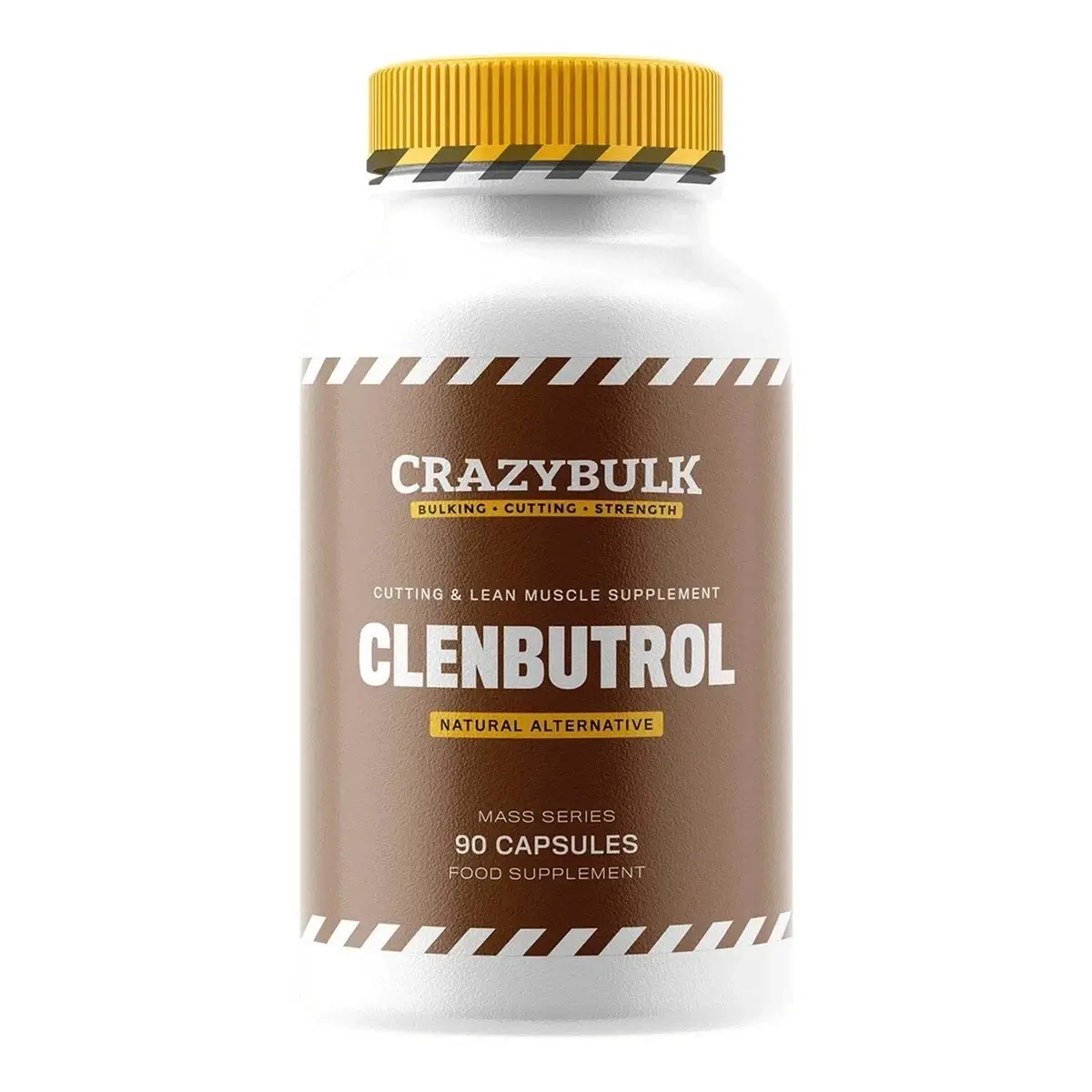
Clenbutrol — CrazyBulk
Thermogenic supplement · 4 capsules daily · £49.99 per month
- No banned ingredients listed — and no beta-2 agonist to detect
- Legal to buy, possess and use in the UK
- Every dose printed on the label, from a company with a published address
- 60-day money-back guarantee
- Contains 200 mg caffeine, a real stimulant dose with its own cautions
- Won’t replicate clenbuterol, and works alongside a deficit rather than instead of one
FAQ
What is clenbuterol’s half-life?
Around 35 hours in human plasma, measured in volunteers given therapeutic oral doses. That’s why effects persist for days and why repeated dosing accumulates rather than clearing between doses.
How long does clenbuterol stay in urine?
At least 7–10 days after a single 80 µg dose in a controlled study, and longer after a cycle of repeated dosing. Urine is the standard doping-control matrix for exactly this reason.
How long before clenbuterol is out of your system completely?
Roughly six to seven days from the last dose for the drug itself, based on four to five half-lives at 35 hours each. Detection windows outlast that by days in urine and considerably longer in hair.
Will clenbuterol show up on a standard drug test?
Not on a routine hospital toxicology screen, which is why disclosure matters in an emergency. In anti-doping testing it very much will — those assays are designed to find it at concentrations far below anything pharmacologically active.
Does drinking water flush clenbuterol out faster?
No. Elimination depends on renal clearance of a heavily protein-bound compound, not on urine volume — and sample dilution is itself flagged in doping control.
How long does clenbuterol stay in hair?
Reported windows extend to months, which is why hair analysis is used for retrospective investigation rather than routine screening. It records a history rather than a snapshot.
References
- Yamamoto I, Iwata K, Nakashima M. Pharmacokinetics of plasma and urine clenbuterol in man, rat, and rabbit. J Pharmacobiodyn. 1985;8(5):385–391. https://pubmed.ncbi.nlm.nih.gov/4045696/
- Solheim SA, et al. Single-dose administration of clenbuterol is detectable in dried blood spots. Drug Testing and Analysis, 2020. https://analyticalsciencejournals.onlinelibrary.wiley.com/doi/abs/10.1002/dta.2872
- Clenbuterol toxicity: an emerging epidemic. A case report and review. PubMed. https://pubmed.ncbi.nlm.nih.gov/17393901/
- Hostrup M, et al. Clenbuterol induces lean mass and muscle protein accretion, but attenuates cardiorespiratory fitness and desensitizes muscle β2-adrenergic signalling. The Journal of Physiology, 2025. https://physoc.onlinelibrary.wiley.com/doi/10.1113/JP289023
- WADA — response on clenbuterol cases and the minimum reporting level. https://www.wada-ama.org/en/news/wada-responds-questions-received-new-york-times-related-clenbuterol-cases-involving-chinese
- UK Anti-Doping — British triathlete receives three-year ban for possession and use of clenbuterol. https://www.ukad.org.uk/news/british-triathlete-louis-walker-receives-three-year-ban-for-possession-and-use-of-clenbuterol
- The Misuse of Drugs Act 1971 (Modification) Order 1996, SI 1996/1300 — legislation.gov.uk. https://www.legislation.gov.uk/uksi/1996/1300/made
- NHS — Anabolic steroid misuse. https://www.nhs.uk/conditions/anabolic-steroid-misuse/
This article is for information and harm-awareness. It is not a guide to evading drug testing, does not provide dosing information, and is not medical advice — if you’re experiencing symptoms after taking anything described here, seek medical attention. NHS services treat these issues without judgement.

Tanveer Quraishi, author of Steroids 101 has extensive experience in the field of bodybuilding and has been writing online on various muscle-building and other health topics for many years now. He is not just interested in bodybuilding but is a great football player too. When he is not writing for his site or training at the gym, he loves to spend his time with this wife and kids.